

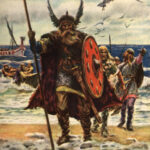
Summary: Valhalla, Hliðskjálf, Valaskjálf, Gladsheim, Sökkvabekk and Asgard, the other places Odin visits, and what each medieval text says about his tie to them.
Odin’s best-known place is Valhalla (Old Norse Valhǫll), the hall where, in the poem Grímnismál, he chooses men killed in battle. The same poem and Snorri Sturluson’s Edda, written in 13th-century Iceland, tie him to other places too: the high seat Hliðskjálf (Hlidskjalf), from which he looks out over all the worlds, the silver-roofed hall Valaskjálf (Valaskjalf), Gladsheim and Sökkvabekk (Sokkvabekk). Snorri places several of them in Asgard (Ásgarðr), the stronghold of the gods.
This page sets out what each medieval text says about each place and how it ties the place to Odin: whether he owns it, rules or presides there, sits there, receives the dead there, or only visits. No text read for this page says in so many words that Odin lives in Valhalla; they call it his hall and show him choosing and welcoming the dead there. Where the texts differ or disagree, the page says which text says what and does not join them into one map. The stories themselves are in Myths of Odin, and historical places of worship are in Worship of Odin.
In the sources
Valhalla, where Odin receives the slain
Grímnismál lists the dwellings of the gods. In stanza 8, the “gold-bright” Valhalla stands in the fifth of them, Gladsheim, and there “each day, Hroptr chooses men killed by weapons” (Pettit’s translation). Hroptr (Hropt) is one of Odin’s names.
The poems call the hall Odin’s. In Grímnismál 9 and 10, “those who come to Óðinn’s” (Pettit) know the hall at once: its rafters are spear-shafts, its roof is made of shields, and mail-coats lie on its benches; a wolf hangs west of the door and an eagle stoops above it. Stanza 25 calls it “Herjafǫðr’s hall”, Herjafǫðr (Herjafodr) being another name for Odin.
Two poems written for dead kings show Odin welcoming them there:
- Eiríksmál, a poem for the dead King Eiríkr (Eirik) preserved in the Old Norse history Fagrskinna (chapter 7), opens with a speaker who dreamed he rose before day “to clear Valhǫll for slain folk”, woke the einherjar (the dead champions), had the benches strewn and the cups rinsed, and had the valkyries bring wine “as if a king were coming” (Eiríksmál 1, paraphrase). Fagrskinna names the speaker as Odin. The god Bragi hears a noise “as if Baldr were coming back to Óðinn’s halls”; it is Eiríkr, coming “into Óðinn’s halls” (Eiríksmál 3 and 4, paraphrase).
- Hákonarmál, by the poet Eyvindr skáldaspillir (Eyvind), opens with Odin, called here Gautatýr (Gautatyr), sending the valkyries Gǫndul and Skǫgul (Gondul and Skogul) “to choose among the kings” which one “should go with Óðinn and be in Valhǫll” (Hákonarmál 1, paraphrase). When King Hákon (Hakon) falls, Odin sends Hermod and Bragi to meet him (stanza 14), and Bragi offers him the peace of the einherjar (stanza 16).
One eddic poem goes further. In the prose of Helgakviða Hundingsbana II (after stanza 38), when the dead hero Helgi comes to Valhalla, Odin “invited him to rule over all with him” (Pettit).
Snorri sets out the hall in more detail. Odin is called Valfǫðr (Valfodr), he says, “because all those that fall in battle are the sons of his adoption” (Gylfaginning 20, Brodeur’s translation). For them he appoints Valhalla and Vingólf (Vingolf), and they are called the Champions. In Gylfaginning 38 the questioner Gangleri says that “all those men who have fallen in battle from the beginning of the world are now come to Odin in Valhall”, and his host agrees. In Gylfaginning 41 the champions arm every day, “go out into the court and fight, and fell each other”, then “ride home to Valhall and sit down to drink” (Brodeur). The eddic poem Vafþrúðnismál 41 tells the same daily fight in “Óðinn’s enclosed fields” (Pettit), without naming Valhalla. According to Gylfaginning 42, the gods built Valhalla after they had made Midgard.
Life in the hall:
- Food: In Grímnismál 18, the cook Andhrímnir (Andhrimnir) boils the boar Sæhrímnir (Saehrimnir) in the cauldron Eldhrímnir (Eldhrimnir), and the einherjar live on it. The stanza does not name Valhalla. Snorri places the boar there and adds that it is boiled every day and is whole again by evening (Gylfaginning 38).
- Drink: In Grímnismál 36 and Gylfaginning 36, valkyries bring the einherjar their ale. Odin himself, in Grímnismál 19, lives on wine alone and feeds his wolves Geri and Freki.
- The goat and the hart: In Grímnismál 25 and 26, the goat Heiðrún (Heidrun) and the hart Eikþyrnir (Eikthyrnir) stand on Herjafǫðr’s hall and bite the branches of a tree called Læraðr (Laerad). Heiðrún fills a vat with mead that never runs dry, and drops from the hart’s horns fall into the spring Hvergelmir, the source of all waters. Snorri names the hall as Valhalla and puts both animals on top of it (Gylfaginning 39). Læraðr is named only in these two texts.
- Size: Grímnismál 24 gives “Five hundred doors and forty” in Valhalla (Pettit), and says that 800 einherjar walk out of each door when they go to fight the wolf. Pettit notes that if the numbers are counted in the old long hundred of 120, they come to 640 doors and 960 men at each door. Snorri quotes the stanza in Gylfaginning 40.
Around the hall:
- In Grímnismál 21 and 22, the river Þund (Thund) roars, and the gate Valgrind “stands on open ground, holy, before holy doors” (Pettit). The poem does not say whose doors. Pettit notes that Valgrind is otherwise unknown.
- “In Ásgard, before the doors of Valhall, there stands a grove which is called Glasir, and its leafage is all red gold” (Skáldskaparmál 34, Brodeur). No eddic poem read for this page names Glasir.
- The mistletoe that kills Baldr grows “westward of Valhall” (Gylfaginning 49, Brodeur).
Other texts mention the hall in passing. In Vǫluspá 33, Frigg weeps in her home Fensalir “for the woe of Valhǫll” (Pettit). In Hyndluljóð 1 and 2, Freyja asks the giantess Hyndla to ride with her to Valhalla to seek Odin’s favour. In Skáldskaparmál 17, the giant Hrungnir, drunk in Asgard, boasts that he will lift up Valhalla and carry it to Jotunheim; when Thor asks who let him in, Hrungnir says Odin invited him. In Skáldskaparmál 33, swords light Valhalla in place of fire.
Snorri’s Edda also opens with a Valhalla of a different kind. In Gylfaginning 2, King Gylfi comes to Asgard and sees a hall roofed with golden shields, and Snorri quotes the poet Þjóðólfr of Hvin (Thjodolf) that “Valhall was thatched with shields” (Brodeur). At the end of the tale the hall vanishes. In the index of his edition, Anthony Faulkes reads this hall as “the palace of the ‘historical’ Æsir in Sweden”, and Valhalla elsewhere in the Edda as “the mythical palace of the gods”.
Hliðskjálf, Odin’s high seat
Hliðskjálf (Old Norse Hliðskjálf) is the seat from which Odin sees the worlds. The texts show him sitting in it; none read for this page says outright that he owns it, and other gods sit in it too.
- In the prose that opens Grímnismál, “Óðinn and Frigg sat in Hliðskjálf and looked through all worlds” (Pettit).
- In Gylfaginning 9, Hliðskjálf is a place in Asgard, “and when Allfather sat in the high-seat there, he looked out over the whole world and saw every man’s acts, and knew all things which he saw” (Brodeur).
- In Gylfaginning 17, Hliðskjálf is the high seat inside the hall Valaskjálf: “Whenever Allfather sits in that seat, he surveys all lands” (Brodeur).
- In Gylfaginning 50, after Baldr’s death, Odin sees from Hliðskjálf where Loki is hiding.
Freyr sits there as well. In the prose that opens Skírnismál, Freyr “had sat himself in Hliðskjálf, and he looked through all worlds” (Pettit), and saw the giant woman Gerðr (Gerd). Snorri tells the same story in Gylfaginning 37 and adds a reason for Freyr’s lovesickness: “his overweening pride, in having presumed to sit in that holy seat, was avenged upon him” (Brodeur). Skírnismál gives no such reason.
Poets also named Odin by the seat. A verse by Þórálfr (Thoralf) quoted in Skáldskaparmál 2 calls him “The Mighty One of Hlidskjálf” (Brodeur). Odin’s objects, including a short note on Hliðskjálf, are on Artifacts of Odin.
Valaskjálf, the silver-roofed hall
Grímnismál 6 names the third dwelling of the gods, roofed with silver. It is called Válaskjálf, and an Áss built it “for himself in early days” (Pettit). An Áss is one of the Æsir (Aesir), the main family of gods. The poem does not say which god built it.
Snorri says whose it is. “Another great abode is there, which is named Valaskjálf; Odin possesses that dwelling; the gods made it and thatched it with sheer silver, and in this hall is the Hlidskjálf, the high-seat so called” (Gylfaginning 17, Brodeur). Of the texts read for this page, this is the only one that says outright that Odin owns a hall.
Gladsheim
Gladsheim (Old Norse Glaðsheimr) appears in two texts, and they describe it differently.
In Grímnismál 8 it is the fifth dwelling of the gods, where Valhalla stands. In Gylfaginning 14 it is a temple. When Asgard was made, Snorri says, Allfather set up rulers to decide fates with him at Iðavǫllr (Idavoll), in the middle of the stronghold. Their first work was a temple with twelve seats for them “and another, the high-seat which Allfather himself has” (Brodeur). It was all gold, inside and out, “and men call it Gladsheim”.
So Grímnismál has Valhalla in Gladsheim, and Snorri has Allfather’s own high seat there. Neither text says the other is wrong, and neither joins the two descriptions.
Sökkvabekk, where Odin drinks with Saga
Sökkvabekk (Old Norse Søkkvabekkr) is the fourth dwelling in Grímnismál. In stanza 7, cool waves wash over it, and there Odin and Sága (Saga) drink every day, glad, from golden cups (paraphrase).
Snorri gives the place to the goddess Sága (Saga) alone: “she dwells at Søkkvabekkr, and that is a great abode” (Gylfaginning 35, Brodeur). He does not mention Odin there. So the poem shows Odin drinking at Sökkvabekk, and Snorri makes it Sága’s home.
Asgard, the gods’ stronghold
Asgard (Old Norse Ásgarðr) is the home of the gods together. In Gylfaginning 9, the sons of Borr “made for themselves in the middle of the world a city which is called Ásgard; men call it Troy. There dwelt the gods and their kindred” (Brodeur). Hliðskjálf is there. In Gylfaginning 14, Allfather sets up its rulers, and their temple, Gladsheim, is built there.
Odin acts in Asgard in several stories. He flies into it as an eagle with the stolen mead and spits it into the vats the gods have set out (Skáldskaparmál 1), and the giant Hrungnir chases him there on horseback (Skáldskaparmál 17). After Ragnarök, the battle at the end of the world, the gods Víðarr and Váli (Vidar and Vali) dwell at Iðavǫllr, “where Ásgard was before” (Gylfaginning 53, Brodeur).
No text read for this page calls Asgard Odin’s own, the way Snorri calls Valaskjálf his. Grímnismál does not use the name at all, and in Vafþrúðnismál 2 Frigg speaks of keeping Odin at home “in the courts of the gods” (Pettit).
Places Odin visits
These places belong to others, or to no one, but a text sets an episode there with Odin present. Visiting a place does not make it his.
- Mímir’s (Mimir’s) well: In Vǫluspá 28, the seeress tells Odin she knows “where you hid your eye” (Pettit): in the spring of Mímir. Snorri says the well lies under the root of the ash Yggdrasil that turns toward the frost giants, and that Odin got one drink from it only after he had laid his eye in pledge (Gylfaginning 15). At Ragnarök, “Odin shall ride to Mímir’s Well and take counsel of Mímir” (Gylfaginning 51, Brodeur).
- Vafþrúðnir’s hall: In Vafþrúðnismál 1 to 5, Odin asks Frigg’s advice, travels to the giant Vafþrúðnir (Vafthrudnir), and “came to a hall, and Ímr’s father owned it” (Pettit), Ímr’s (Imr’s) father being Vafþrúðnir. There the two hold a contest of wisdom.
- Geirrǫðr’s hall: In the opening prose of Grímnismál, Odin, calling himself Grímnir (Grimnir), comes to the hall of the human king Geirrǫðr (Geirrod), who sets him between two fires for eight nights. Only Agnarr, the king’s son, brings him a drink.
- Suttungr’s halls: In Hávamál 104 and 105, Odin says he visited “the ancient giant” and spoke to his own advantage “in Suttungr’s halls” (Pettit); there Gunnlod gave him a drink of the mead. Only Snorri names the place where Suttungr (Suttung) kept the mead: “the place called Hnitbjörg” (Hnitbjorg; Skáldskaparmál 1, Brodeur).
- The road to Hel: In Baldrs draumar 2 and 3, Odin saddles Sleipnir, rides “down to Niflhel”, and comes to “the high hall of Hel” (Pettit). In stanza 4 he wakes a dead seeress there. For Hel as one of the worlds, see Hel.
- The windy tree: In Hávamál 138, the speaker hangs “on a windy tree” (Pettit) for nine nights, a tree whose roots, he says, no one knows. The poem does not name the tree. Pettit thinks it is “probably Yggdrasill”; the identification is his.
- Vígríðr: In Vafþrúðnismál 18, Vígríðr (Vigrid) is the field where Surtr (Surt) and the gods will meet in battle, “a hundred leagues in every direction” (Pettit). At Ragnarök, “Odin rides first” there against the wolf Fenrir (Gylfaginning 51, Brodeur).
Odin also leads the gods as guests to the feast of the sea giant Ægir (Aegir) in Skáldskaparmál 33.
Odin’s homes in the legendary histories
Some medieval histories tell of Odin as a man, a king later taken for a god. They put him in real lands. These are literary accounts written by Christian authors; for the archaeology and worship at the places they name, see Worship of Odin.
- The Prologue to Snorri’s Edda places Troy near the middle of the world, “even that which we call Turkland” (Brodeur), and has Odin travel north from there to Saxland (Saxony) and Sweden, where he founds Sigtún (Sigtuna).
- Ynglinga saga, also by Snorri, puts a city called Ásgarðr in Asia, east of the river Tanakvísl (Tanakvisl), with Odin as its chief (chapter 2). Odin leaves it, settles first on an island “now called Óðinsey” (Odinsey) on Funen, and then by the lake Lǫgrinn (Logrinn), at the place now called “Old Sigtúnir” (Sigtunir), where he builds a great temple (chapter 5, paraphrase). Dying, he says he will go to Goðheimr (Godheim), and the Swedes believe he has gone back to “the old Ásgarðr” (chapters 9 and 10, paraphrase).
- The Danish historian Saxo Grammaticus, writing in Latin, says Odin chose to dwell at Uppsala (Gesta Danorum 1.7.1), and that “the gods, whose chief seat was then at Byzantium”, drove him out for a time (3.4.9, Elton’s translation). Elton’s English adds “(Asgard)” after Byzantium; Saxo’s Latin has no such word. Turville-Petre notes that Valhalla “is nowhere named in Saxo’s work” (Myth and Religion of the North, 1964, p. 32).
Where the accounts differ
Some of these accounts describe a place differently without ruling each other out; others contradict each other. Each item says which.
- Where Valhalla stands: Grímnismál 8 puts it in Gladsheim, and Skáldskaparmál 34 puts its doors in Asgard. These are different descriptions, not a contradiction: Grímnismál does not mention Asgard, and Snorri does not put Valhalla in Gladsheim. No text read for this page joins the two.
- Who goes to Valhalla: In Grímnismál 8, Odin chooses men killed by weapons every day. In Grímnismál 14 and Gylfaginning 24, Freyja chooses half the slain for her dwelling Fólkvangr (Folkvang), and Odin has the other half. Yet in Gylfaginning 38, Snorri’s speakers agree that all who have fallen in battle since the world began are with Odin. In Ynglinga saga 8, Odin’s law says each man comes to Valhalla with the goods burned with him on his pyre. In Hákonarmál 1, valkyries choose which king goes there. These accounts do conflict, and two of them are Snorri’s own: the texts give no single rule.
- Where Hliðskjálf stands: In Gylfaginning 9 it is a place in Asgard; in Gylfaginning 17 it is a high seat inside Valaskjálf, among the dwellings “in heaven” (Brodeur). Both chapters are Snorri’s, and the second is more specific. They may describe the same seat in two framings that he does not reconcile. The poems do not say where it is.
- Who built Valaskjálf: In Grímnismál 6 an unnamed god built it for himself; in Gylfaginning 17 the gods made it and Odin owns it. Snorri may be naming an owner the poem leaves unnamed; the texts do not settle it.
- Vingólf: Snorri uses the name three ways. In Gylfaginning 3, righteous men will live with Allfather “in the place called Gimlé or Vingólf” (Gimle or Vingolf; paraphrase of the Old Norse þar sem heitir Gimlé eða Vingólf; Brodeur’s translation leaves out “or Vingólf”). In Gylfaginning 14 it is the goddesses’ shrine. In Gylfaginning 20 Odin appoints it, with Valhalla, for those who fall in battle. Faulkes notes that “there certainly seem to be inconsistencies” (2005, note to 32/4). This is a conflict within Snorri’s own text.
- What Asgard is: In Gylfaginning and Skáldskaparmál it is the stronghold of the gods. In the Prologue and Ynglinga saga it is a human city in Asia, and Gylfaginning 9 itself says “men call it Troy”. Snorri runs these two pictures side by side, the mythic and the historical, and does not choose between them.
Interpretations
- Valhalla as a picture: E. O. G. Turville-Petre wrote that the only detailed descriptions of Valhalla are in Grímnismál and Snorri, that “the description of Valholl has more to do with art than with popular belief”, and that the hall is “modelled on a royal palace”. He reported M. Olsen’s comparison with a Roman amphitheatre, the Colosseum, and thought it should not be dismissed lightly (Myth and Religion of the North, 1964, pp. 53-54).
- The name Valhalla: Turville-Petre took it “more probably” as “castle of the slain”. He also noted that rocks in southern Sweden called Valhall were thought to be dwellings of the dead, so the second part of the name may first have meant “rock”, which poets turned into a palace. Odin may have presided there “originally perhaps as god of death rather than as god of war” (1964, pp. 53-54).
- Hliðskjálf: Turville-Petre wrote that Snorri thinks of it as “a kind of throne” in Asgard, and that the name may mean “the hill, rock with an opening in it” (1964, pp. 62-63). Edward Pettit glosses it “Door/Inlet Shelf” (2023, note to the Grímnismál prose). Turville-Petre reported Olsen’s speculative link between Hliðskjálf, Valaskjálf and Odin’s avenging sons, and gave the simpler view that the names “imply little more than that Odinn and his sons were lords of the rock” (pp. 62-63).
- Valaskjálf: Pettit suggests the name may mean “Váli’s Shelf”, Váli being Baldr’s avenger, or perhaps “Shelf of the Slaughtered”, and that the god who built it may be Váli or just “a god” (2023, notes to Grímnismál 6).
- Sága and Frigg: Pettit suggests that Sága, Odin’s drinking companion at Sökkvabekk, may first have been another name for Frigg, whose home Fensalir in Vǫluspá 33 is also watery (2023, note to Grímnismál 7).
- Vingólf: Faulkes thinks Snorri may be identifying the champions in Valhalla with the righteous in Gimlé by linking both to Vingólf, and that the inconsistencies ease if Vingólf and Gimlé are taken as part of Valhalla (2005, notes to 21/29 and 32/4).
- Gladsheim: Pettit glosses the name “Home of Gladness” or “Glade’s Home” (2023, note to Grímnismál 8).
- Grímnismál itself: Pettit notes that the poem “may well have oral roots in the pagan period”, but its date and place of origin are uncertain (2023, introduction to Grímnismál).
Sources
Primary texts
- Gylfaginning, Skáldskaparmál and the Prologue, in Snorri Sturluson’s Edda: Guðni Jónsson, normalised text (heimskringla.no); Anthony Faulkes (ed.), Edda: Prologue and Gylfaginning, 2nd ed., Viking Society for Northern Research, 2005. English: Arthur Gilchrist Brodeur (tr.), The Prose Edda, 1916, public domain (Wikisource). Chapter numbers follow Brodeur.
- Eddic poems (Grímnismál, Vǫluspá, Vafþrúðnismál, Baldrs draumar, Hávamál, Skírnismál, Helgakviða Hundingsbana II, Hyndluljóð): Edward Pettit (ed. and tr.), The Poetic Edda: A Dual-Language Edition, Open Book Publishers, 2023, CC BY-NC 4.0 (PDF). Stanza numbers follow Pettit; older translations number some Grímnismál stanzas one lower (Pettit’s stanza 24 is stanza 23 in Bellows).
- Eiríksmál and Hákonarmál: Finnur Jónsson (ed.), Carmina Scaldica, 1929 (heimskringla.no); Fagrskinna, chapter 7, for the frame of Eiríksmál: Finnur Jónsson’s text (heimskringla.no).
- Ynglinga saga: N. Linder and H. A. Haggson (eds), Heimskringla, 1869-72 (heimskringla.no).
- Saxo Grammaticus, Gesta Danorum 1.7.1 and 3.4.9: J. Olrik and H. Ræder (eds), 1931. English: Oliver Elton (tr.), The First Nine Books of the Danish History of Saxo Grammaticus, 1894, public domain.
English renderings marked “paraphrase” are this page’s own.
Scholarship
- Faulkes, Anthony. Edda: Prologue and Gylfaginning, 2nd ed., 2005: notes and index (PDF, Viking Society).
- Pettit, Edward. The Poetic Edda: A Dual-Language Edition. Open Book Publishers, 2023: introductions and notes.
- Turville-Petre, E. O. G. Myth and Religion of the North. 1964.
Further reading
- Myths of Odin (NorsePath wiki page): the stories set in these places, from the mead of poetry to Ragnarök.
- Names and titles of Odin (NorsePath wiki page): Hroptr, Herjafǫðr, Valfǫðr and the other names the texts use for him here.
- Odin in Culture (NorsePath wiki page): Odin, Valhalla and Asgard in later art, literature and film.
- Edward Pettit, The Poetic Edda (dual-language edition, 2023, open access above): Grímnismál with notes on each of the gods’ dwellings.
