

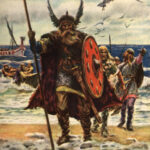
Summary: Gungnir, Draupnir, Andvari's ring, the whetstone, the auger Rati and the other objects the medieval texts give Odin, and how each one relates to him.
Odin’s best-known artifacts are his spear Gungnir and his gold ring Draupnir. Both were made by dwarfs and given to him, as Snorri Sturluson (1179-1241) tells in his Edda, written in 13th-century Iceland. Other texts give him a helmet and mail-coat, a whetstone, an auger, spears he lends or gives away, and a few things he holds for a time, such as Andvari’s ring and Freyja’s necklace.
This page lists what the medieval texts say about each object and how the object relates to Odin: owned, used, given away, or held for a time. Where the texts disagree, it says which text says what.
In the sources
Gungnir, Odin’s spear
Odin’s spear is Gungnir (Old Norse Gungnir, often written Gugnir in the manuscripts). Snorri’s prose tells of it in two episodes: where it is made, and at Ragnarök, the battle at the end of the world.
In Skáldskaparmál 35, Loki cuts off the hair of Thor’s wife Sif. To make amends he goes to the dwarfs called the sons of Ívaldi (Ivaldi), who make golden hair for Sif, the ship Skíðblaðnir (Skidbladnir), and “the spear which became Odin’s possession, and was called Gungnir” (Brodeur’s translation). Loki then gives the spear to Odin. This story of the gods’ treasures is found only in Snorri’s Edda.
Loki tells the gods that “the spear would never stop in its thrust” (Skáldskaparmál 35, Brodeur). No other text read for this page gives it a power, and none says that Gungnir never misses its target.
At Ragnarök, “Odin rides first with the gold helmet and a fair birnie, and his spear, which is called Gungnir” (Gylfaginning 51, Brodeur). He rides against the wolf Fenrir, and the wolf swallows him.
The valkyrie’s speech in Sigrdrífumál 17 lists the places where runes were once cut, among them “Gungnir’s point” (Bellows’s translation). The poet Kormákr (Kormak) has “Hroptr bore with him Gungnir” (Brodeur’s translation), Hroptr (Hropt) being one of Odin’s names (Sigurðardrápa 7, quoted in Skáldskaparmál 2). A loose verse ascribed to the poet Bragi (Finnur Jónsson’s “Ubestemmelige vers” 2) has Gungnis váfuðr, “swinger of Gungnir”. Finnur Jónsson read it as Odin, whose horse the line names; Hjalmar Falk read it as a warrior, a “spear-Odin”, and the horse as his ship (Falk 1924, pp. 32-33, note).
For a shorter entry, see Gungnir.
Other spears in Odin’s stories
Several texts tie Odin to a spear, or to something he throws, without naming Gungnir. None of them says it is Gungnir, and the tie differs from text to text: he throws, lends or gives it, takes his spear back, is marked with a spear point, or is wounded with one.
- The first war: In Vǫluspá 24, “Odin let fly and shot into the host”, which begins the war between the Æsir and the Vanir. The Old Norse does not say what he threw. Bellows’s translation supplies “spear”, and Pettit’s notes that the weapon “is not stated”.
- The spear he lends: In the prose of Helgakviða Hundingsbana II (after stanza 29), Dagr (Dag) sacrifices to Odin to avenge his father, and “Odin lent Dagr his spear” (paraphrase). Dagr kills Helgi with it.
- The spear he gives as a reed: In Gautreks saga 7, Hrosshárs-Grani (Hrosshars-Grani), whom the gods at an assembly greet as Odin, hands the hero Starkaðr (Starkad) a spear and says it will look like a reed stalk. Starkaðr stabs King Víkarr (Vikar) with the reed, saying “now I give you to Odin”, and the reed becomes a spear (paraphrase).
- The spear in the otter story: After the gods pay the ransom for Otr (Otter) in Skáldskaparmál 39, “Odin had taken his spear, and Loki his shoes” (Brodeur).
- The spear point at his death: In Ynglinga saga 10, where Odin is a human king of the Swedes, the dying Odin “had himself marked with a spear point” (paraphrase) and claimed all men who die by weapons.
- The spear in the hanging: In Hávamál 138, the speaker hangs on the tree “wounded with a spear” and “given to Odin, myself to myself” (paraphrase). The poem does not name the spear or say whose it is.
Draupnir, the ring that drips gold
Draupnir (Old Norse Draupnir, “the dripper”) is a gold ring from which eight rings “of equal weight” drop every ninth night. Three texts give this property: Skáldskaparmál 35, Gylfaginning 49 and Skírnismál 21. The texts describe what it does; they do not say what it stands for.
In Skáldskaparmál 35, after Loki wagers his head that no dwarf can match the sons of Ívaldi, the dwarf Brokkr works the bellows while his brother forges a boar with golden bristles, the hammer Mjǫllnir (Mjolnir) and Draupnir. Brokkr gives the ring to Odin and says “that eight rings of the same weight would drop from it every ninth night” (Brodeur). The manuscripts differ on the smith’s name: one calls him Eitri, and in another the name was left blank and later filled in as Sindri (Faulkes 1998, textual notes to p. 42, lines 2 and 17).
When Baldr dies, “Odin laid on the pyre that gold ring which is called Draupnir” (Gylfaginning 49, Brodeur). Hermod rides to Hel to ask for Baldr back, and Baldr “took the ring Draupnir and sent it to Odin for a remembrance”. The full story is told in Death of Baldr.
In Skírnismál 21, Skírnir (Skirnir), the servant of Freyr, offers the giant woman Gerðr (Gerd) “the ring that was burned / Of old with Othin’s son”, from which eight of like weight fall every ninth night (Bellows). The poem does not name the ring. Gerðr turns it down: her father has gold enough.
For a shorter entry, see Draupnir.
Andvari’s ring
A second ring in Odin’s story can make wealth. In Skáldskaparmál 39, Odin, Loki and Hœnir (Hoenir) must pay a ransom of gold for killing Otr. Loki takes all the gold of the dwarf Andvari. Andvari tries to keep one small ring, “saying that from this ring he could multiply wealth for himself if he might keep it” (Brodeur), and curses it when Loki takes it.
Odin sees the ring, finds it fair, and takes it out of the treasure. When the gold is heaped over the otter’s skin, one whisker still shows, and Odin draws out the ring to cover it. The prose of Reginsmál tells the same moment: Odin draws out the ring Andvaranautr (“Andvari’s gift”) and covers the hair. So Odin holds this ring only for a short time. It then passes, with its curse, to Sigurðr (Sigurd) and to the Gjúkungar, the sons of Gjúki.
The whetstone and the auger Rati
Two tools belong to the story of how Odin won the mead of poetry, told in Skáldskaparmál 1 (Brodeur’s numbering; Faulkes 1998, pp. 3-5) and, more briefly, in Hávamál 104-110. For the story itself, see Myths of Odin.
- The whetstone: Odin “took a hone from his belt” and sharpened the scythes of nine thralls. They all wanted to buy it. He threw it into the air, and they killed one another with their scythes scrambling for it (Skáldskaparmál 1, Brodeur; Faulkes 1998, p. 4). Only Snorri tells this; Hávamál has no whetstone.
- Rati: Calling himself Bǫlverkr (Bolverk), Odin “drew out the auger called Rati” and had the giant Baugi bore through the rock to the mead (Skáldskaparmál 1, Brodeur; Faulkes 1998, p. 4). In Hávamál 106 the speaker says that Rati’s mouth made room for him through the stone. Pettit notes that it is not certain Rati is a proper name (note to Hávamál 106).
- The vessels: The mead was kept in the kettle Óðrerir (Odrerir) and the vats Són (Son) and Boðn (Bodn). They belonged first to the dwarfs who made the mead from the blood of Kvasir, then to the giant Suttungr (Suttung). Odin took what was in them, not the vessels: he emptied all three in three drinks, given him by Gunnlod (Skáldskaparmál 1; Faulkes 1998, p. 4).
Helmet, mail, cloak and hood
- Helmet and mail: At Ragnarök Odin wears a gold helmet and a fair mail-coat (Gylfaginning 51). One of his names in Grímnismál 46 is Hjálmberi, “helmet-bearer”.
- Cloak: In the prose of Grímnismál, Odin, calling himself Grímnir (Grimnir), wears “a dark-blue mantle” (Bellows), which catches fire when he is set between two fires.
- Hood: Another of his names in Grímnismál 48 is Síðhǫttr, “deep hood”. In Vǫlsunga saga and in Styrbjarnar þáttr, a one-eyed or hooded stranger wears a deep hood; these sagas do not name him (see below).
- No eye-patch: No medieval text read for this page gives Odin an eye-patch. The texts read give him a deep hood; the broad-brimmed hat appears in modern retellings such as Guerber’s (see “In modern reception”).
Did Odin have a sword?
No text read for this page gives Odin a sword of his own. The sword closest to him is in Vǫlsunga saga 3. A tall, old, one-eyed stranger in a spotted cloak and a deep hood drives a sword into the tree Barnstokkr (Barnstokk) and says that whoever draws it shall have it as a gift from him. Only Sigmundr (Sigmund) can. The saga does not name the stranger.
In Vǫlsunga saga 11, a one-eyed man in a blue cloak and deep hood, carrying a spear, meets Sigmundr in battle, and Sigmundr’s sword breaks on the spear. This man is not named either. But in chapter 12 the dying Sigmundr says that “Odin does not want us to draw the sword, since it has now broken” (paraphrase).
Things given, taken or held for a time
- Skíðblaðnir: Snorri’s Edda and Grímnismál 43 give the folding ship Skíðblaðnir to Freyr. Only Ynglinga saga 7 says that “Odin owned a ship called Skíðblaðnir”, on which he crossed great seas, and which could be folded like a cloth (paraphrase).
- Freyja’s necklace: In Sǫrla þáttr, a late tale in the 14th-century manuscript Flateyjarbók, four dwarfs make a gold necklace for Freyja. Odin hears of it from Loki and orders him to get it. Loki slips into her locked bower as a fly, bites her as a flea so that she turns over, then takes back his own shape, unfastens the necklace and brings it to Odin. Odin gives it back only on a condition: she must set two kings fighting in a battle where the fallen rise again, until a Christian man dares to enter it and kill them. The tale calls it only “the necklace”; it does not use the name Brísingamen.
- The apple: In Vǫlsunga saga 2, King Rerir and his queen pray for a child. Frigg tells Odin, and he sends the giant Hrímnir’s (Hrimnir’s) daughter to the king with an apple. The king takes it home to the queen, and she soon finds that she is with child.
- The golden image: The Danish historian Saxo Grammaticus, writing in Latin, says that the kings of the North sent a golden image of Odin, its arms hung with bracelets, to Byzantium. Frigg had the gold stripped off, and Odin made the statue speak when touched (Gesta Danorum 1.7). Saxo writes of Odin as a man falsely held to be a god.
Mímir’s head
Mímir’s (Mimir’s) head is a being’s head rather than a made object, but the texts say Odin kept it. In Ynglinga saga 4, the Vanir behead Mímir and send the head to the Æsir. Odin embalms it with herbs and sings spells over it, so that it speaks to him and tells him hidden things; in chapter 7 he keeps it with him. In Vǫluspá 46, as Ragnarök begins, “Odin speaks with Mímir’s head” (paraphrase), and in Sigrdrífumál 14 Mímir’s head speaks.
Where the sources disagree
- When Draupnir got its power: In Skáldskaparmál 35 the ring drips gold from the day it is made. One manuscript of Gylfaginning 49 adds the word síðan, “afterwards”, so that the ring has the power only after it is burned on Baldr’s pyre; other manuscripts lack the word. Skírnismál 21 also ties the dripping ring to the burning. Faulkes, the editor of both texts, notes the conflict and says it is not certain which reading is older.
- Who owns Draupnir: In Skáldskaparmál 35 and Gylfaginning 49, Odin owns it before and after the pyre. In Skáldskaparmál 5, Baldr may be called “owner of Hringhorni and Draupnir”. In Skírnismál, Freyr’s servant offers it, and no text says how Freyr’s side came to have it.
- Who owns Skíðblaðnir: Freyr, in Gylfaginning 43, Skáldskaparmál 35 and Grímnismál 43; Odin, in Ynglinga saga 7 only.
- Which spear: The spears in Hávamál 138 and Vǫlsunga saga 11 are not named, and Vǫluspá 24 does not say what Odin threw. Among the texts read for this page, Gungnir is named in Snorri’s prose, in Kormákr’s verse, in Sigrdrífumál 17 and in the verse ascribed to Bragi.
- Who the stranger is: The one-eyed men of Vǫlsunga saga 3 and 11 and the hooded man of Styrbjarnar þáttr are not named. Gautreks saga names Hrosshárs-Grani as Odin.
His high seat and his animals
Odin’s high seat Hliðskjálf (Hlidskjalf), from which he sees all the worlds, stands in his hall Valaskjálf (Valaskjalf) (Gylfaginning 9 and 17); it belongs with his halls and places. His horse Sleipnir, his ravens Hugin and Munin and his wolves Geri and Freki are living companions, not possessions, and have their own pages.
Interpretations
- The spear as Odin’s weapon: E. O. G. Turville-Petre called the spear “Óðinn’s favourite weapon”. He noted that the poet Egill (Egil) called Odin “lord of the spear” (geirs dróttinn, Sonatorrek 22), and that it fits his cult: in Hávamál 138 the hanged god is wounded with a spear, and in Gautreks saga the man “given” to Odin is both hanged and stabbed (Myth and Religion of the North, 1964, pp. 43, 45, 47).
- Is the spear in Hávamál Gungnir? Leszek Gardeła writes that “it is impossible to know for certain” whether the spear of Hávamál 138 is Gungnir, though the two were plausibly linked in Norse thought (2022, p. 399).
- Miniature spears: Small spear-shaped objects found in Viking-age graves have been read as symbols of Odin. Gardeła sees reasons for the link but leaves the question open (2022, p. 411).
- The name: Edward Pettit glosses Gungnir as “Wavering/Shaking One” (2023, note to Sigrdrífumál 17) and Draupnir as “Dripper” (note to Skírnismál 21). Gardeła renders Gungnir “swaying one” (2022, p. 399).
- The treasures story: Anthony Faulkes notes that Snorri’s tale of Sif’s hair and the gods’ treasures “has no parallel in extant sources”, and that it is unknown whether he drew it from lost poems or from oral stories (1998, p. xxiv).
- Two rings that make gold: Faulkes points out that Andvari’s ring is “another ring that can reproduce itself” (1998, note to p. 42, line 10). Bellows made the same comparison in 1923 (note to Skírnismál 21).
- Rings and oaths: In Hávamál 110 the speaker says “I think Óðinn has sworn a ring-oath” and asks “how can his pledges be trusted?” (Pettit’s translation). Pettit notes that the speaker’s identity is uncertain, and that “oaths sworn on rings are well-attested in Old Norse literature” (2023, note to Hávamál 110). The poem does not say the ring was Draupnir or that it was Odin’s.
In modern reception
Some familiar details about Odin’s objects appear in 19th- and early 20th-century works but not in the medieval texts read for this page. Two examples:
- H. A. Guerber’s popular Myths of the Norsemen (1909) calls Gungnir “infallible” and says that an oath sworn on its point could never be broken. It says Odin made the spear from a branch of Yggdrasil, wore Draupnir as “the emblem of fruitfulness”, put on an eagle helmet for battle, and wore a broad-brimmed hat to hide his missing eye. None of these details was found in the medieval texts read for this page.
- In Richard Wagner’s opera Siegfried, Wotan cut his spear’s shaft from a bough of the world-ash and carved treaties on it in runes. No medieval text read for this page says this of Gungnir.
For Odin in later art, literature and film, see Odin in Culture.
Sources
Primary texts
- Gylfaginning and Skáldskaparmál, in Snorri Sturluson’s Edda: Guðni Jónsson, normalised text (heimskringla.no); Anthony Faulkes (ed.), Edda: Prologue and Gylfaginning, 2nd ed., Viking Society for Northern Research, 2005; Anthony Faulkes (ed.), Edda: Skáldskaparmál, Viking Society for Northern Research, 1998. English: Arthur Gilchrist Brodeur (tr.), The Prose Edda, 1916, public domain (Wikisource). Chapter numbers follow Brodeur.
- Eddic poems (Vǫluspá, Hávamál, Grímnismál, Skírnismál, Sigrdrífumál, Reginsmál, Helgakviða Hundingsbana II): Guðni Jónsson, Eddukvæði (heimskringla.no), and Edward Pettit (ed. and tr.), The Poetic Edda: A Dual-Language Edition, 2023. English quotations: Henry Adams Bellows (tr.), The Poetic Edda, 1923, public domain (Wikisource). Stanza numbers follow the Codex Regius; Bellows numbers some stanzas differently.
- Kormákr Ǫgmundarson, Sigurðardrápa 7, as quoted in Skáldskaparmál 2; Bragi Boddason, “Ubestemmelige vers” 2, in Finnur Jónsson (ed.), Den norsk-islandske skjaldedigtning B1, with his Danish translation (heimskringla.no); Egill Skalla-Grímsson, Sonatorrek 22.
- Ynglinga saga: N. Linder and H. A. Haggson (eds), Heimskringla, 1869-72.
- Vǫlsunga saga, Gautreks saga and Sǫrla þáttr eða Heðins saga ok Hǫgna: Guðni Jónsson and Bjarni Vilhjálmsson (eds), Fornaldarsögur Norðurlanda (heimskringla.no).
- Styrbjarnar þáttr Svíakappa, Flateyjarbók text (heimskringla.no).
- Saxo Grammaticus, Gesta Danorum 1.7: J. Olrik and H. Ræder (eds), 1931. English: Oliver Elton (tr.), The First Nine Books of the Danish History of Saxo Grammaticus, public domain.
English renderings marked “paraphrase” are this page’s own.
Scholarship
- Bellows, Henry Adams. Notes to The Poetic Edda, 1923.
- Faulkes, Anthony. Edda: Prologue and Gylfaginning, 2nd ed., 2005: introduction and notes (PDF, Viking Society).
- Faulkes, Anthony. Edda: Skáldskaparmál, 1998: introduction, notes, textual notes and index.
- Falk, Hjalmar. Odensheite. Videnskapsselskapets Skrifter II, Hist.-filos. klasse 1924, no. 10. Kristiania, 1924.
- Gardeła, Leszek. “Miniature Spears in the Viking Age: Small Symbols of Óðinn?” Religionsvidenskabeligt Tidsskrift 74 (2022), 396-430.
- Pettit, Edward. The Poetic Edda: A Dual-Language Edition. Open Book Publishers, 2023, CC BY-NC 4.0 (PDF).
- Turville-Petre, E. O. G. Myth and Religion of the North. 1964.
Modern reception
- Guerber, H. A. Myths of the Norsemen: From the Eddas and Sagas. George G. Harrap, 1909.
- Wagner, Richard. Siegfried, Act I, in Margaret Armour’s English translation, Siegfried & The Twilight of the Gods. William Heinemann.
Further reading
- Myths of Odin (NorsePath wiki page): the stories in which these objects appear, from the mead of poetry to Ragnarök.
- Names and titles of Odin (NorsePath wiki page): names such as Hjálmberi and Síðhǫttr, and the poets’ names for him.
- Edward Pettit, The Poetic Edda (dual-language edition, 2023, open access above): the eddic poems with notes on Gungnir, Draupnir and Rati.
