

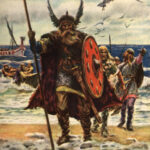
Odin’s parents are Borr (Bor) and Bestla, his brothers are Vili and Vé (Ve), and his wife is Frigg. Those links rest on Snorri Sturluson’s Prose Edda together with older skaldic verse. His best-attested sons are Thor, Baldr, Váli (Vali) and Víðarr (Vidar). Beyond these, the medieval texts name many more children, and on several of them, Týr (Tyr) above all, they disagree.
This page sets out what each text says, relationship by relationship, and marks how firm each link is. Stories in which these relatives act are told on Myths of Odin.
How to read this page. Each relationship carries one of four marks:
- attested: two or more independent texts state it, and no text in the same kind of account states something incompatible;
- source-specific: only one text, or one author’s works, states it;
- disputed: another text in the same kind of account states something incompatible, such as another father, or every text that states it differs between editions or manuscripts on the word that carries it;
- uncertain: every text that states it rests on an editor’s conjecture or on unclear or implied wording, or the link depends on scholars identifying two figures as one.
A mark is judged on all the texts that state a relationship together, not on one passage. Only a text whose wording states the relationship firmly is counted. A passage with a doubtful word, a restored name or only implied wording is reported, but it neither adds to the count nor lowers the mark when a firm witness exists. Hermóðr (Hermod) is an example: the editions of Gylfaginning differ on whether he is Odin’s son or his servant, but the verse list of sons names him without that doubt, so his mark is source-specific.
Snorri’s Gylfaginning, Skáldskaparmál and Ynglinga saga count as one author’s works. Snorri wrote in Christian Iceland in the 13th century. A poem he quotes counts as that poem’s witness. The mythic accounts are kept apart from Snorri’s euhemerised history in the Prologue and Ynglinga saga, from Saxo’s Gesta Danorum and from the Anglo-Saxon royal lines, because those texts treat Odin as a human king. A conflict counts only inside its own kind of account, so the same relationship can carry one mark in the myths and another in the histories; Sæmingr (Saeming) is the case on this page. Stanza numbers for the eddic poems follow Guðni Jónsson’s edition; where Bellows’s 1923 translation numbers a stanza differently, his number follows in brackets.
The family at a glance
| Relative | Relationship to Odin | Main texts | Mark |
|---|---|---|---|
| Borr (Bor) | father | Gylfaginning 6; skaldic kenning; Vǫluspá in skamma 2 | attested |
| Bestla | mother | Gylfaginning 6; Vellekla 4 | attested |
| Bölþorn (Bolthorn), a giant | maternal grandfather (Bestla’s father) | Gylfaginning 6; Hávamál 140 | attested |
| Búri (Buri) | paternal grandfather | Gylfaginning 6 | source-specific |
| Vili | brother | Gylfaginning 6; Sonatorrek 23; Ynglingatal | attested |
| Vé (Ve) | brother | Gylfaginning 6; Ynglinga saga 3 | source-specific |
| Frigg | wife | Gylfaginning 9; Lokasenna; skaldic kennings; Saxo; Paul the Deacon | attested |
| Frigg | mother of Baldr | Skáldskaparmál 5, 19 | source-specific |
| Jǫrð (Earth) | wife | Gylfaginning 9; Skáldskaparmál; skaldic kennings | attested |
| Jǫrð (Earth) | mother of Thor | Gylfaginning 9, 36; Skáldskaparmál 4, 24; eddic and skaldic “Jǫrð’s son” | attested |
| Jǫrð (Earth) | daughter | Gylfaginning 9 only, against Gylfaginning 10 | disputed |
| Rindr (Rind) | mother of Váli | Gylfaginning 30; Baldrs draumar 11 | attested |
| Gunnlǫð (Gunnlod) | lover; no child named in the texts read | Hávamál; Skáldskaparmál | attested |
| Gríðr (Grid), a giantess | mother of Víðarr | Skáldskaparmál 18 | source-specific |
| Skaði (Skadi) | wife: marriage stated in Ynglinga saga 9 (Snorri’s history) | Ynglinga saga 9 | source-specific |
| Skaði (Skadi) | bore Odin many sons | Háleygjatal 3-4, quoted in Ynglinga saga 9 (one witness with the saga) | source-specific |
| Thor | son | Gylfaginning; Hárbarðsljóð; Vǫluspá; skalds; Saxo; the þula | attested |
| Baldr | son | Gylfaginning; Vǫluspá; Baldrs draumar; Húsdrápa; Saxo; the þula | attested |
| Váli (Vali) | son; his mother is Rindr (row above) | Gylfaginning; Vǫluspá; Baldrs draumar; the þula | attested |
| Víðarr (Vidar) | son; his mother Gríðr is source-specific (row above) | Skáldskaparmál; Vǫluspá; Lokasenna; the þula | attested |
| Heimdallr (Heimdall) | son | Skáldskaparmál 8; the þula | attested |
| Hǫðr (Hodr) | son | Skáldskaparmál 13 | source-specific |
| Hermóðr (Hermod) | son | the þula; Gylfaginning 49 in some editions (not counted) | source-specific |
| Bragi | son | Skáldskaparmál 10 | source-specific |
| Meili | son | the þula | source-specific |
| Nepr, Hildólfr (Hildolf), Ítreksjóð (Itreksjod) | sons | the þula only | source-specific |
| Sæmingr (Saeming) | son, in the myths; no mother named | the þula, with the Prologue and Ynglinga saga agreeing from the histories | attested |
| Sæmingr (Saeming) | son, in Snorri’s histories; mother Skaði in Ynglinga saga 9 only | Prologue 5; Ynglinga saga 9; against the Prologue to Heimskringla, where his father is Yngvi-Freyr | disputed |
| Týr (Tyr) | son | Skáldskaparmál 9, against Hymiskviða 5 | disputed |
| Loki | blood-brother (sworn kin) | Lokasenna 9 | source-specific |
“The þula” is the verse list of Odin’s sons in the Nafnaþulur (Skáldskaparmál verse 429 in Faulkes’s edition). It counts as one witness however many names it holds. Each mark covers only the relationship in its own row.
Key: A attested   S source-specific   D disputed   U uncertain
     ═ marriage stated in a text   ─ parent, partner or other tie
     Each mark covers only the link it follows.

Búri  (S)
 └─ Borr (A)  ═══  Bestla (A), daughter of the giant Bölþorn (A)
     ├─ ODIN
     │    ├═ wife: Frigg (A)
     │    │    └─ Baldr: Odin's son (A); Frigg as his mother (S)
     │    ├═ wife: Jǫrð (A) ··· also called his daughter (D)
     │    │    └─ Thor: Odin's son (A); Jǫrð as his mother (A)
     │    ├─ Rindr, mother of Váli (A)
     │    │    └─ Váli: Odin's son (A)
     │    ├─ Gríðr, mother of Víðarr (S)
     │    │    └─ Víðarr: Odin's son (A)
     │    ├─ Skaði, partner in skaldic verse (marriage: see the histories below)
     │    │    └─ "many sons", none named in the verse: Háleygjatal 3-4 (S)
     │    ├─ Gunnlǫð, lover; no child named in the texts read (A)
     │    ├─ sons with no mother named in the myths:
     │    │    Heimdallr (A)   Hǫðr (S)   Hermóðr (S)
     │    │    Bragi (S)       Meili (S)  Týr (D)
     │    │    Sæmingr, in the þula (A)
     │    │    Nepr, Hildólfr, Ítreksjóð (S)
     │    └─ sworn kin: Loki, blood-brother (S)
     ├─ Vili (A)
     └─ Vé  (S)

Snorri's histories (kept apart from the myths above):
  ODIN ═ Skaði: marriage, Ynglinga saga 9 (S)
  Sæmingr, ancestor of Hákon jarl (D)
     father Odin, mother Skaði ....... Ynglinga saga 9
     father Odin, no mother named .... Prologue to the Edda 5
     father Yngvi-Freyr .............. Prologue to Heimskringla (Hkr I 4),
                                       cited via Faulkes 1998, p. 156
In the sources
Parents and grandparents
Gylfaginning. Snorri gives the fullest account. Búri (Old Norse Búri) was licked out of the salt stones at the beginning of the world, and he begat a son called Borr (Gylfaginning 6). In Brodeur’s public-domain translation, Borr “wedded the woman named Bestla, daughter of Bölthorn the giant; and they had three sons: one was Odin, the second Vili, the third Vé” (Gylfaginning 6). Snorri calls Bölþorn a giant (Old Norse jǫtunn) but does not use that word for Bestla herself (Gylfaginning 6). The three “sons of Borr” then kill Ymir and shape the world from him (Gylfaginning 7-9).
Skaldic verse. Two poems quoted in Skáldskaparmál name the same parents. Einarr skálaglamm calls Odin “son of Bestla” (son Bestlu; Vellekla 4, Skáldskaparmál verse 25). Þorvaldr blǫnduskáld calls him “son of Borr, heir of Búri” (burar Bors, Búra arfa; Skáldskaparmál verse 26). “Heir” (arfi) can mean any descendant, so only Gylfaginning fixes Búri as grandfather.
Eddic poems. No eddic poem names Bestla as Odin’s mother or Borr as his father outright. Vǫluspá in skamma comes closest: “The father of Baldr was the heir of Bur” (Vǫluspá in skamma 2, Bellows Hyndluljóð 31). Vǫluspá 4 says the “sons of Burr” (Burs synir) raised the land, without naming them. In Hávamál 140 (Bellows 141) the speaker learns nine songs “from the son / Of Bolthorn, Bestla’s father”. The stanza does not say that Bestla is the speaker’s mother.
Other settings. The Prologue to Snorri’s Edda gives a separate, euhemerised line in which Odin is a king descended from the Trojans. There, Odin (Vóden) is the son of “Fríallaf (whom we call Fridleifr)”, and his remote ancestor is “Trór, whom we call Thor”, a grandson of King Priam through his daughter Tróan (Prologue 3, Brodeur). The Skáldskaparmál epilogue goes further and implies that Odin was Priam himself (Skáldskaparmál, Eptirmáli). The Anglo-Saxon Chronicle names Woden’s father as Friþuwulf in the annals for 547 and 560 and as Friþuwald in the annal for 855, so the Chronicle’s manuscript A is not consistent with itself. In Baldrs draumar 6 Odin calls himself Vegtamr, “son of Valtamr”, but this is a disguise that is broken later in the poem (Baldrs draumar 13).
Brothers
Snorri names Vili and Vé as Borr and Bestla’s second and third sons (Gylfaginning 6). In Ynglinga saga he adds a story: Odin had two brothers, Vé and Vili, who ruled while he was away; once, thinking him lost, they divided his inheritance and both took his wife Frigg, until Odin came back and took her again (Ynglinga saga 3).
Vili is also named as Odin’s brother by two poets. Egill Skallagrímsson calls Odin “brother of Vílir” (bróður Vílis; Sonatorrek 23), and Þjóðólfr of Hvinir uses “Vilja bróður” (Ynglingatal 3 in Finnur Jónsson’s edition). Vé has no such second witness and is source-specific to Snorri.
The only eddic poem to name the pair is Lokasenna. Loki taunts Frigg: “For Vili and Ve, thou wife of Vithrir, / Both in thy bosom have lain” (Lokasenna 26, Bellows). The stanza fits the Ynglinga saga story, but it does not call Vili and Vé Odin’s brothers.
No text read for this page names a sister of Odin.
Frigg, his wife
Frigg is the one wife every kind of source agrees on. Snorri writes: “His wife was called Frigg daughter of Fjörgvinn; and of their blood is come that kindred which we call the races of the Æsir” (Gylfaginning 9, Brodeur), and again “Frigg is his wife” (Frigg er kona hans; Gylfaginning 20). The prose opening of Lokasenna says that “Odin came, and Frigg his wife” to the feast (Óðinn ok Frigg, kona hans), and the poem calls her “wife of Viðrir” (Viðris kvæn), Viðrir being one of Odin’s names (Lokasenna 26). Þorbjǫrn hornklofi calls Odin “dweller in Frigg’s embrace” (Friggjar faðmbyggvi; Haraldskvæði 12, Skáldskaparmál verse 9).
Outside Iceland, Saxo Grammaticus makes Frigga the wife (coniunx, uxor) of Othinus; in his story she strips gold from her husband’s statue, is unfaithful with a servant, and dies (Gesta Danorum I 1.7.1-1.7.3). In Lombard legend, Paul the Deacon names Frea as “the wife of Godan” (Fream, uxorem Godan; Historia Langobardorum I.8), as does the earlier Origo gentis Langobardorum (chapter 1). The Prologue’s human Odin also has a wife: “His wife was Frígídá, whom we call Frigg” (Prologue 3, Brodeur).
Her father. Snorri names her father as Fjǫrgvinn or Fjorgynn (Fjǫrgynn; Gylfaginning 9; Skáldskaparmál 19). No other text states it. In Lokasenna 26 Loki calls Frigg Fjörgyns mær, where mær can mean “maid”, “daughter”, “wife” or “beloved”; Bellows translates “Fjorgyn’s wife”. The phrase cannot settle who her father was (see “Interpretations”).
Not marriage. Several passages show Frigg beside Odin without naming any family tie: they sit together in Hliðskjálfa (Hlidskjalf, Odin’s watch-tower; Bellows: “Gate-Shelf”) (Grímnismál, prose opening) and she counsels him (Vafþrúðnismál 1-4). The goddess Sága (Saga) drinks with Odin every day in Søkkvabekkr (Sokkvabekk; Bellows: “the Sinking Stream”) (Grímnismál 7); the poem names no family tie between them.
Jǫrð, the Earth
Jǫrð (Old Norse Jǫrð, “Earth”; the site’s Jord) is the second figure the texts call Odin’s wife. In one sentence Snorri makes her both his daughter and his wife: “The Earth was his daughter and his wife; on her he begot the first son, which is Ása-Thor” (Gylfaginning 9, Brodeur).
- Wife: Skáldskaparmál states that “in poesy the earth is called the Wife of Odin” (Skáldskaparmál 2, Brodeur), and gives kennings for her as “bride of Odin” and “bride of Báleygr” (Skáldskaparmál 24; verse 119). Þjóðólfr of Hvinir calls her “Svǫlnir’s widow” (Svǫlnis ekkja), Svǫlnir being an Odin name (Haustlǫng 15). These verses make the marriage attested.
- Mother of Thor: Snorri says it several times: Thor is “son of Odin and Jǫrð” (Skáldskaparmál 4), and “Jǫrð, Thor’s mother” is counted among the goddesses (Gylfaginning 36). Eddic and skaldic poems call Thor “Jǫrð’s son” (Jarðar burr, Þrymskviða 1; Jarðar sunr, Lokasenna 58; Haustlǫng 14). They never name Odin and Jǫrð in the same clause.
- Daughter, disputed: in the next chapter Snorri gives Jǫrð other parents, Nótt (Night) and Ánarr (Annar) (Gylfaginning 10). Skáldskaparmál calls her “daughter of Ónarr” and “daughter of Nótt” and never “daughter of Odin” (Skáldskaparmál 24), and Hallfreðr’s verse calls her “only daughter of Ónarr” (eingadóttur Ónars; Skáldskaparmál verse 118). Odin as her father therefore stands in one sentence only, against Snorri’s own second account.
Two eddic passages name Thor’s mother differently. Hárbarðsljóð 56 says “Fjǫrgyn (Fjorgyn) will meet Thor, her son”, and Vǫluspá 56 (Bellows 55-56) calls Thor “son of Hlóðyn” (Hlodyn) and “son of Fjǫrgyn”. Editors and scholars take Fjǫrgyn (a feminine name, distinct from Frigg’s father) and Hlóðyn to be names of Jǫrð; the poems do not say so, and Hárbarðsljóð 4-5 even claims Thor’s mother is dead. As partners of Odin these names are uncertain.
Rindr and the birth of Váli
Snorri writes: “One is called Áli or Váli, son of Odin and Rindr” (Gylfaginning 30, Brodeur), and calls Váli “son of Odin and Rindr, stepson of Frigg” (Skáldskaparmál 12). He counts Rindr among the goddesses but never calls her Odin’s wife (Gylfaginning 36). Baldrs draumar has the same mother: “Rind bears Vali in Vestrsalir, / And one night old fights Othin’s son” (Baldrs draumar 11, Bellows); Vestrsalir is “The Western Hall” in Bellows’s note. The name “Vála” in that line is an editor’s restoration, missing from the poem’s manuscript; the mother and “Othin’s son” are in the manuscript (Pettit 2023, note to Baldrs draumar 11). With both texts, Rind as mother of Odin’s son is attested.
A verse by Kormákr says “Odin wrought charms on Rindr” (Seið Yggr til Rindar; Skáldskaparmál verse 12, Brodeur). Saxo tells a longer and darker story. A seer foretells that Othinus will have another son by Rinda, daughter of the king of the Ruthenians (alium filium ex Rinda Rutenorum regis filia). Rinda refuses him in several disguises, and he takes her by force disguised as a healer called Wecha (one variant in Saxo has her father allow it); she bears a son, Bous (Gesta Danorum III 3.4.1-3.4.13). Saxo never speaks of a marriage. The name Váli does not occur in his Latin, and the equation of Bous with Váli is a modern editor’s, not Saxo’s.
Other lovers and partners
- Gunnlod (Gunnlǫð). In the story of the mead of poetry, Odin lies with Gunnlǫð for three nights (Skáldskaparmál G57-58), and Hávamál has him boast of it and admit “And Gunnloth to grief he left” (Hávamál 110, Bellows; also 13, 105, 108). No text read gives her a child by Odin; none says she had none.
- Gríðr (Gríðr). Skáldskaparmál calls this giantess the “mother of Vídarr the Silent” (Skáldskaparmál 18, Brodeur). The passage does not name Odin, but other texts call Víðarr his son (see “Sons”). Gríðr appears in no other text read.
- Skadi (Skaði). In Ynglinga saga Skaði would not live with Njǫrðr, “and afterwards married Odin; they had many sons” (Ynglinga saga 9, paraphrase). The saga quotes Eyvindr skáldaspillir’s Háleygjatal, in which the giantess “bore many sons with Odin” (Háleygjatal 3-4, paraphrase). Since the saga’s prose rests on the stanzas it quotes, the two count as one witness. Gylfaginning makes Skaði only Njǫrðr’s wife (Gylfaginning 23).
- Frigg’s rivals: Skáldskaparmál lists kennings for Frigg as the “rival” (elja) of Jǫrð, Rindr, Gunnlǫð and Gerðr (Gerd) (Skáldskaparmál 19). Gerðr is otherwise Freyr’s wife, and Faulkes suggests the name may be an error for Gríðr; one manuscript has the name altered with “Gerðar” in the margin (Faulkes 1998, note to 30/10). Gerðr as Odin’s partner is uncertain.
- Freyja: one manuscript of Skáldskaparmál calls Freyja “wife of Odin” where the others read “wife of Óðr”; Faulkes treats Odin as a scribal error (Skáldskaparmál 20, Faulkes’s textual note). It is no evidence that Snorri made Freyja Odin’s wife.
- Failed and doubtful unions: in Hávamál Odin pursues Billingr’s (Billing’s) daughter and is tricked: “And nought from the woman I won” (Hávamál 96-102, Bellows 102). In Hárbarðsljóð the ferryman Hárbarðr (Harbard) boasts of seven sisters and other women (Hárbarðsljóð 16-30); the poem never says Hárbarðr is Odin, and only Grímnismál 49 lists the name among Odin’s.
Sons
Thor is the son with the widest support. Snorri calls him Odin’s first son, by Jǫrð (Gylfaginning 9). In the eddic poems Thor says “I am Othin’s son, / Meili’s brother, and Magni’s father” (Hárbarðsljóð 9, Bellows), and he is “Odin’s son” in Vǫluspá 56, Þrymskviða 21 and 32, and Hymiskviða 35. Bragi Boddason calls him “son of Aldafǫðr” (“father of men”, an Odin name) (Ragnarsdrápa 14). Saxo reports it as “a matter of common belief, that Thor was Odin’s son” (Gesta Danorum VI, Elton). The þula lists him (Nafnaþulur 18).
Baldr is “the second son of Odin” in Snorri (Gylfaginning 22, Brodeur). Vǫluspá calls him “Odin’s child” (Óðins barni; Vǫluspá 31, Bellows 32), Baldrs draumar “Othin’s son” (Baldrs draumar 8-9, Bellows), and Úlfr Uggason “son of Odin” (Húsdrápa 6). Saxo has “Balderus, son of Othinus” but names no mother and calls him a demigod (Gesta Danorum III 3.2.3-3.2.4). Only Skáldskaparmál states that Frigg is his mother: “son of Odin and Frigg” (Skáldskaparmál 5; 19). Gylfaginning 49, Lokasenna 27 and Vǫluspá 33 present Frigg as his mother in all but the word, so Frigg’s motherhood is source-specific.
Vali (Váli), son of Rindr, is born to avenge Baldr. Snorri names him (Gylfaginning 30). Vǫluspá tells of Baldr’s brother who, “Odin’s son”, fought when one night old, without naming him (Vǫluspá 32-33, Bellows 33-34). Baldrs draumar 11 names him, though the name there is restored (see “Rindr and the birth of Váli”). Vǫluspá in skamma says Váli avenged “his brother” (Vǫluspá in skamma 1). Snorri treats Áli as another name for the same son (Gylfaginning 30). The þula lists Váli and Áli as two names, and that distinction is disputed.
Vidar (Víðarr) is “son of Odin” in Skáldskaparmál 11 and in the prose opening of Lokasenna, and “son of Sigfǫðr” (“victory-father”, an Odin name; mögr Sigföður, paraphrase) in Vǫluspá 55 (Bellows 54), where he avenges his father on the wolf. Vafþrúðnismál 53 and Grímnismál 17 also make him his father’s avenger. His mother is Gríðr in Skáldskaparmál 18 only.
Heimdall (Heimdallr). Skáldskaparmál calls him “son of nine mothers” and “son of Odin” (Skáldskaparmál 8), and the þula lists him. Both witnesses are lists, and no narrative states it. Gylfaginning 27 and Vǫluspá in skamma 7-9 give him nine giant mothers and name no father. Their silence does not contradict Skáldskaparmál.
Hodr (Hǫðr), Baldr’s slayer, is called “son of Odin” in Skáldskaparmál 13. Faulkes takes that reading from three manuscripts (T, W, U) where his base manuscript R has the plural (Faulkes 1998, textual note to 19/30). Guðni Jónsson’s text of the þula ends “Höðr ok Bragi”, a line Faulkes’s edition records only as a variant (Faulkes 2005, index). The eddic poems call Hǫðr Baldr’s slayer and give him no father (Baldrs draumar 9; Vǫluspá 62). In Saxo, Høtherus is the son of King Hothbrodus and no kin to Odin or Balder (Gesta Danorum II-III), but that belongs to Saxo’s history of kings. Hǫðr as Odin’s son is source-specific.
Hermod (Hermóðr) rides to Hel to ransom Baldr. Guðni Jónsson’s edition calls him “Hermóðr the Bold, Odin’s son” (Gylfaginning 49), but Faulkes’s edition reads sveinn Óðins, where sveinn can mean “boy” or “servant”. The þula lists him among the sons without that doubt. Hákonarmál 14 and Hyndluljóð 2 name a Hermóðr with no family tie.
Bragi, the god of poetry, is “son of Odin” in Skáldskaparmál 10 and in Guðni Jónsson’s variant line of the þula. Gylfaginning 26 gives him no parents, and Hákonarmál 14 makes him Odin’s messenger.
Meili is named as Thor’s brother: Thor calls himself “Meili’s brother” (Hárbarðsljóð 9, Bellows), and Þjóðólfr’s Haustlǫng 14 calls Thor the same. Neither poem names Meili’s father. Only the þula lists Meili as Odin’s son.
Tyr (Týr) is the clearest conflict. Skáldskaparmál calls him “the one-handed god … son of Odin” (Skáldskaparmál 9), while in Hymiskviða Týr speaks of the giant Hymir as “my father” (Hymiskviða 5), and the next stanzas name his giant grandmother and his mother (Hymiskviða 8-11). Gylfaginning 25 gives Týr no parents, and the þula does not list him.
The þula of sons. The Nafnaþulur list “Synir Óðins” reads, in Guðni Jónsson’s text: Baldr, Meili, Víðarr, Nepr, Váli, Áli, Thor, Hildólfr, Hermóðr, Sigi, Skjǫldr, Yngvifreyr, Ítreksjóð, Heimdallr, Sæmingr, Hǫðr and Bragi (Nafnaþulur 18). Faulkes prints the same list without its last line (Skáldskaparmál verse 429). Nepr, Hildólfr and Ítreksjóð are known from this list alone. The þulur are anonymous and are assumed to date from the 12th century (Faulkes 1998, note to verses 412-517).
Saxo’s Froger. Saxo says of Frogerus that “according to some, he was the son of Odin” (Gesta Danorum IV 4.8.1, Elton). No other text names him as Odin’s son.
Daughters
The only daughter any text names is Jǫrð, in Gylfaginning 9, and that claim is disputed (see “Jǫrð, the Earth”). The valkyries are called “Odin’s maidens” (Óðins meyjar; Nafnaþulur 26), and no text calls them his daughters.
Grandchildren and in-laws
- Magni and Modi (Móði) are Thor’s sons (Gylfaginning 53; Hárbarðsljóð 9; Vafþrúðnismál 51). Magni’s mother is the giantess Járnsaxa (Jarnsaxa) (Skáldskaparmál 17).
- Þrúðr (Thrud) is Thor’s daughter (Skáldskaparmál 4).
- Forseti is the son of Baldr and Nanna (Gylfaginning 32).
- Ullr is Thor’s stepson: Snorri calls Thor “stepfather of Ullr” (Skáldskaparmál 4).
- Daughters-in-law: Nanna, daughter of Nepr, is Baldr’s wife, and Frigg is “Nanna’s mother-in-law” (Gylfaginning 32; Skáldskaparmál 19). Sif is Thor’s wife (Lokasenna, prose; Skáldskaparmál 4). Gefjon married Skjǫldr, “son of Odin” (Ynglinga saga 5). No text links Nanna’s father Nepr with the Nepr of the þula.
Loki and foster kin
Loki. No text read makes Odin and Loki kin by birth; their tie is a sworn one. In Lokasenna Loki reminds Odin: “Remember, Othin, in olden days / That we both our blood have mixed” (Lokasenna 9, Bellows). Odin does not deny it and has Víðarr make room for Loki at the feast (Lokasenna 10). No other text read mentions this oath. Snorri makes Loki the son of the giant Fárbauti (Farbauti), and his kennings for Loki as “companion and bench-mate of Odin” leave unclear whether any kinship is meant (Skáldskaparmál 16). In Lokasenna 16 Iðunn (Idunn) speaks of “wish-sons” (óskmegir); Bellows translates this as a statement that Loki was chosen as a wish-son, but the stanza does not name Odin.
Fosterlings. In the prose of Grímnismál Odin calls King Geirröðr (Geirrod) “my fosterling” (Geirröðr, fóstri minn). In Gautreks saga Hrosshárs-Grani, whom the council greets as Odin, calls the hero Starkaðr (Starkad) his fosterling (Gautreks saga IV, VII).
Figurative kinship. Snorri calls Odin Alfǫðr, “father of all the gods and of men”, and says the gods “all serve him as children obey a father” (Gylfaginning 9, 20, Brodeur). These are titles; Names and titles of Odin treats them. They are not part of his genealogy.
Royal lines that claim descent from Odin
Several medieval genealogies begin with Odin. This page names only the son each text gives as the first generation.
- Prologue to the Edda: Odin sets his sons over kingdoms: Vegdeg over East Saxland; Baldeg, “whom we call Baldr”, over Westphalia; Sigi over Frakland (Frankland), ancestor of the Vǫlsungar (Volsungs); Skjǫldr (Skjold) over Reiðgotaland (Reidgotaland), ancestor of the Skjǫldungar (Skjoldungs); Sæmingr over Norway; and Yngvi, king in Sweden after him, ancestor of the Ynglingar (Ynglings) (Prologue 4-5).
- Ynglinga saga: Skjǫldr, “son of Odin”, marries Gefjon (Ynglinga saga 5), and Sæmingr, son of Odin and Skaði, is the ancestor of Hákon jarl (Earl Hakon) (Ynglinga saga 9). Snorri’s own Prologue to Heimskringla names another father: there Sæmingr is the son of Yngvi-Freyr (Heimskringla I 4, cited via Faulkes 1998, note to verse 5, p. 156, and Faulkes 1978-9, note 14). Inside Snorri’s histories Sæmingr’s father is therefore disputed. In the myths the þula lists Sæmingr among Odin’s sons with no mother, and no mythic text names another father. The same saga makes Yngvi another name of Freyr, son of Njǫrðr (Ynglinga saga 11-12), and Skáldskaparmál makes Yngvi the son of Hálfdan the Old (Skáldskaparmál 64). Yngvi as Odin’s son is therefore disputed.
- Skaldic verse: Háleygjatal counts the line of the jarls of Hlaðir “to the gods” (Háleygjatal 1), and Einarr skálaglamm calls Hákon jarl “kinsman of Yggr”, an Odin name (Vellekla 20). The name Sæmingr is not in Háleygjatal‘s surviving stanzas; it comes from an editor’s heading. Snorri gives two accounts of the poem’s line, with Sæmingr as Odin’s son in one and Yngvi-Freyr’s in the other (Faulkes 1978-9, note 14).
- Vǫlsunga saga: Sigi “was called and said to be the son of Odin” (Vǫlsunga saga I, paraphrase).
- Anglo-Saxon lines: Bede traces Hengist and Horsa back to “Uoden” through his son Uecta (Historia ecclesiastica I.15). The Anglo-Saxon Chronicle gives Woden’s son as Bældæg for the West Saxons and Bernicia, Wægdæg for Deira and Wihtlæg for Mercia (annals 494, 547, 552, 560, 597, 626, 755, 855).
Not every line starts with Odin. Hyndluljóð traces the Skjǫldungar, Ynglingar and others to Hálfdan the Old, and no eddic poem about the Vǫlsungar states their descent from Odin.
Where the sources disagree
- Odin’s father: Borr in Gylfaginning 6 and the skaldic kennings; Friðleifr in the Prologue’s Trojan line (Prologue 3); Friþuwulf or Friþuwald in the Anglo-Saxon Chronicle. Only the first belongs to the myths.
- Thor: son or ancestor: the myths make Thor Odin’s son. The Prologue makes Trór, “whom we call Thor”, Odin’s ancestor eighteen generations back (Prologue 3).
- Jǫrð’s parents: Odin in Gylfaginning 9; Nótt and Ánarr in Gylfaginning 10 and Skáldskaparmál 24.
- Thor’s mother: Jǫrð in Snorri and in the poems that call Thor “Jǫrð’s son”; Fjǫrgyn and Hlóðyn in Hárbarðsljóð 56 and Vǫluspá 56.
- Týr’s father: Odin in Skáldskaparmál 9; the giant Hymir in Hymiskviða 5.
- Heimdallr, Hǫðr, Bragi, Hermóðr, Meili: each is Odin’s son in Skáldskaparmál or the þula only; the eddic poems never call them his sons.
- Áli and Váli: one son with two names in Gylfaginning 30; two names listed side by side in the þula.
- Hǫðr in Saxo: son of Hothbrodus and unrelated to Balder in Saxo’s history (Gesta Danorum II-III).
- Skaði: married to Odin in Ynglinga saga 9; in Háleygjatal 3-4 she bears him many sons, and the stanzas do not say they married; only Njǫrðr’s wife in Gylfaginning 23.
- Sæmingr’s father: Odin in the Prologue to the Edda 5 and in Ynglinga saga 9, which names Skaði as his mother; Yngvi-Freyr in the Prologue to Heimskringla (Heimskringla I 4, cited via Faulkes 1998, p. 156). In the myths only the þula names him, as Odin’s son.
- The founder of the Ynglingar: Yngvi, son of Odin (Prologue 5); Yngvi-Freyr, son of Njǫrðr (Ynglinga saga 11-12); Yngvi, son of Hálfdan (Skáldskaparmál 64).
- Frigg’s death: only Saxo has Frigga die (Gesta Danorum I 1.7.3).
Interpretations
Snorri as systematiser. Anthony Faulkes argues that the genealogies in the Prologue were partly “derived from English genealogical tables” and that such genealogy was a product of learned antiquarian work, not popular lore (Faulkes 2005, Introduction p. xxiii). He keeps the Prologue’s human Odin apart from the god, “Óðinn Borsson” (Faulkes 2005, note to 11/16-19). In his study of royal descent he finds that Skjǫldr was apparently made Odin’s son only in the 12th century (Faulkes 1978-9, web version p. 3), and that the gods’ family ties in genealogies differ widely from those in the myths (p. 4). E. O. G. Turville-Petre likewise judges the Sigi, Skjǫldr and Yngvi links to be learned conjecture shaped by English genealogies of Woden, while allowing that the Hlaðir jarls’ descent from Sæmingr, son of Odin and Skaði, may be older (Turville-Petre 1964, p. 56). Faulkes is less sure that Háleygjatal‘s line began with Odin at all (Faulkes 1978-9, web version p. 7).
Jǫrð as daughter and wife. Turville-Petre calls Snorri’s statement one of his less consistent passages (Turville-Petre 1964, p. 55). Faulkes notes that Snorri’s phrase for begetting Thor “on” her could also mean making a child “out of” earth, that the ambiguity may be intended, and that Snorri evidently knew more than one tradition about her parents (Faulkes 2005, notes to 13/20 and 13/25).
“Fjǫrgyns mær”. Scholars read Lokasenna 26 in four ways. Grimm and Faulkes’s 1998 index take it as “Fjǫrgynn’s daughter”, agreeing with Snorri. Faulkes’s 2005 index allows that mær may mean “wife” and Fjǫrgynn may be a name of Odin; Bellows takes it that way. Turville-Petre prefers “Fjǫrgynn’s mistress” (Turville-Petre 1964, p. 97). Pettit lists all four senses without choosing (Pettit 2023, note to Lokasenna 26).
Only one proper wife? Faulkes suggests that calling the other women Frigg’s “rivals” may imply that only Frigg was Odin’s proper wife, and that the other unions were probably all thought of as being with giantesses (Faulkes 1998, note to 30/10). Faulkes describes Rindr as “Óðinn’s mistress … probably a giantess” (Faulkes 2005, index), though Snorri counts her among the goddesses.
Odin’s maternal uncle. Turville-Petre and Pettit read the “son of Bölþorn” in Hávamál 140 as Odin’s maternal uncle (Turville-Petre 1964, p. 49; Pettit 2023, note to Hávamál 140). Bellows was more cautious: “We do not know the name of the uncle”, though Mímir had been suggested (Bellows 1923, note to Hávamál 141). The poem itself does not say “uncle”.
Týr. Bellows found it unclear why Týr calls Hymir his father; Finnur Jónsson emended “father” to “grandfather” to remove the conflict (Bellows 1923, note to Hymiskviða 5). Pettit observes that only Hymiskviða makes Týr a giant’s son (Pettit 2023, note to Hymiskviða 5). Turville-Petre leaves the two accounts unreconciled (Turville-Petre 1964, p. 181).
Heimdallr. Turville-Petre first calls it improbable that the son of nine mothers had Odin for his father (Turville-Petre 1964, p. 55), but later says it may be arbitrary to reject Snorri’s plain statement (p. 155). He also reports Georges Dumézil’s reading of Vǫluspá 1, in which Heimdallr is an ancestor of the gods.
Hermóðr. Faulkes’s index calls him “servant or son of Óðinn” because of the word sveinn (Faulkes 2005, index), and Pettit notes that only Gylfaginning makes him Odin’s son and that the Hermóðr of Hyndluljóð 2 is human (Pettit 2023, p. 823).
Loki. Faulkes and Pettit note that the blood-brotherhood appears only in Lokasenna (Faulkes 1998, note to 20/2; Pettit 2023, p. 314). Turville-Petre reads mixing blood as an oath of foster-brotherhood (Turville-Petre 1964, p. 130). Bellows observes that no story tells how the oath was sworn, but finds it reasonable (Bellows 1923, note to Lokasenna 9).
Frigg beyond Scandinavia. Turville-Petre takes Paul the Deacon’s story to show Wotan already married to Frea, that is Frigg, in Lombard tradition (Turville-Petre 1964, p. 73).
Coverage and gaps
This page rests on the texts listed under “Sources”, read in the editions named there.
- Editions: Ynglinga saga was read in Linder and Haggson’s edition of 1869-72, and its chapter numbers have not been checked against the Íslenzk fornrit edition.
- Not found: no text read names Frigg as the mother of Hǫðr or Hermóðr, gives Gunnlǫð a child, names a sister of Odin, or makes Loki Odin’s blood-brother outside Lokasenna.
- Out of scope: Sleipnir, the ravens and the wolves are covered with Odin’s companions. Figures linked to Odin only by company, such as Sága, Mímir, Hœnir and the valkyries, are not family and are left out of the table and diagram.
Sources
Primary texts
- Gylfaginning, Skáldskaparmál and the Prologue to Snorri Sturluson’s Edda: Guðni Jónsson, normalised text (heimskringla.no); Anthony Faulkes (ed.), Edda: Prologue and Gylfaginning, 2nd ed., Viking Society for Northern Research, 2005; Anthony Faulkes (ed.), Edda: Skáldskaparmál, Viking Society for Northern Research, 1998. English: Arthur Gilchrist Brodeur (tr.), The Prose Edda, 1916, public domain (Wikisource).
- Nafnaþulur: Guðni Jónsson, Snorra-Edda, Viðauki I; = Skáldskaparmál verse 429 in Faulkes 1998.
- Ynglinga saga: N. Linder and H. A. Haggson (eds), Heimskringla, 1869-72. English renderings on this page are paraphrase.
- Eddic poems (Vǫluspá, Vǫluspá in skamma, Hávamál, Baldrs draumar, Lokasenna, Hárbarðsljóð, Grímnismál, Vafþrúðnismál, Skírnismál, Þrymskviða, Hymiskviða, Alvíssmál, Hyndluljóð): Guðni Jónsson, Eddukvæði (heimskringla.no). English: Henry Adams Bellows (tr.), The Poetic Edda, 1923, public domain (Wikisource).
- Skaldic poems (Vellekla, Sonatorrek, Ynglingatal, Haraldskvæði, Haustlǫng, Ragnarsdrápa, Húsdrápa, Háleygjatal, Hákonarmál): Finnur Jónsson (ed.), Den norsk-islandske skjaldedigtning B1, and Carmina Scaldica; quoted in Skáldskaparmál where the verse number is given.
- Vǫlsunga saga and Gautreks saga: Guðni Jónsson, normalised text.
- Saxo Grammaticus, Gesta Danorum I-IX: J. Olrik and H. Ræder (eds), 1931. English: Oliver Elton (tr.), The First Nine Books of the Danish History of Saxo Grammaticus, read in the Norroena Society reprint of 1905, public domain.
- Bede, Historia ecclesiastica gentis Anglorum I.15, Latin text.
- Anglo-Saxon Chronicle, manuscript A, with Janet Bately’s notes.
- Paul the Deacon, Historia Langobardorum I.8; Origo gentis Langobardorum 1, Latin texts.
Scholarship
- Bellows, Henry Adams. Notes to The Poetic Edda, 1923.
- Faulkes, Anthony. Edda: Prologue and Gylfaginning, 2nd ed., 2005: Introduction, notes and index (PDF, Viking Society).
- Faulkes, Anthony. Edda: Skáldskaparmál, 1998: Introduction, notes, textual notes and index.
- Faulkes, Anthony. “Descent from the gods”. Mediaeval Scandinavia 11 (1978-9, published 1983), 92-125; corrected web version (PDF, Viking Society).
- Grimm, Jacob. Teutonic Mythology I, tr. J. S. Stallybrass, 1882.
- Pettit, Edward. The Poetic Edda: A Dual-Language Edition. Open Book Publishers, 2023, CC BY-NC 4.0 (PDF).
- Turville-Petre, E. O. G. Myth and Religion of the North. 1964.
- Dumézil’s reading of Vǫluspá 1 is cited via Turville-Petre 1964, p. 155; original not consulted (not available on 2026-11-25).
- Snorri Sturluson’s Prologue to Heimskringla (Heimskringla I 4), on Sæmingr as son of Yngvi-Freyr, is cited via Faulkes 1998, General notes to verse 5, p. 156, Faulkes 1978-9, note 14 (web version p. 5), and Faulkes 2005, index, p. 176; original not consulted (not read for this page).
- Finnur Jónsson’s emendation of Hymiskviða 5 is cited via Bellows 1923, note to Hymiskviða 5; original not consulted (not available on 2026-11-25).
Further reading
- Myths of Odin (NorsePath wiki page): the stories in which Frigg, Baldr, Váli, Gunnlǫð and Rindr appear.
- Anthony Faulkes, “Descent from the gods” (article, 1978-9, free PDF above): the fullest study of how medieval genealogies made kings descend from Odin.
- Edward Pettit, The Poetic Edda (dual-language edition, 2023, open access above): the eddic poems with notes on each kinship passage.
