

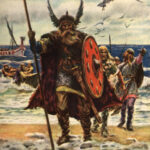
Odin (Old Norse Óðinn) is described as Allfather, a seeker of wisdom, a master of magic and a giver of victory. The same sources show him deceiving others and taking victory away (Gylfaginning 20; Hávamál 104 to 110, 138 to 163; Eiríksmál 7).
“Archetype” is a modern label for these recurring roles. No medieval text uses the word or sorts Odin’s roles into types. The ten groups below are drawn from the passages cited in this guide.
Odin’s ten roles at a glance
| Role | What the sources describe |
|---|---|
| Sovereign and Allfather | highest of the gods, father of gods and of royal lines |
| Seeker and giver of wisdom | wins knowledge at a cost and passes on counsel |
| Seer who knows fate but cannot change his own | learns what is fated, shapes others’ lots, meets his own end |
| Master of magic | runes, spells (galdr), seiðr (a form of sorcery), shape-changing |
| Giver of poetry | wins the mead of poetry and gives it to poets |
| God of war, giver and withholder of victory | decides battles, favours and abandons kings |
| Lord of the slain and the dead | claims the battle-dead, the hanged and the sacrificed |
| Wanderer in disguise | travels under false names to test, give or take |
| Deceiver, seducer and breaker of faith | wins by deceit, seduces, breaks oaths |
| God of fury and ecstasy | gives fury to warriors and frenzy to poets |
The sections below distinguish what the medieval sources say, how named scholars interpret them, and how modern Heathen groups and practitioners understand Odin. Modern beliefs are presented as modern, and disagreements between sources remain visible.
For the names and titles used in these accounts, see Names and titles of Odin.
This is a selective survey. Its coverage and the limits of access to scholarship are explained under Sources.
In the references
English in quotation marks in this section is quoted from the public-domain translation named beside it (Brodeur, Bellows or Elton; see Sources). All other English here is this reference’s paraphrase of the original text cited, and carries no quotation marks.
Sovereign and Allfather
Snorri’s Gylfaginning (13th century, Christian Iceland) says: “Odin is highest and eldest of the Æsir: he rules all things, and mighty as are the other gods, they all serve him as children obey a father” (Gylfaginning 20, Brodeur). It explains the name Alfǫðr (All-father): “Odin is called Allfather because he is father of all the gods” (Gylfaginning 20, Brodeur). He made heaven and earth and gave man a soul (Gylfaginning 3), and in Völuspá he gives the first humans breath (Völuspá 18). Grímnismál calls him foremost of the Æsir (Grímnismál 44).
Völuspá calls Baldr Odin’s child (Völuspá 31) and Víðarr the son of Sigföðr (victory-father), a name of Odin (Völuspá 55; Gylfaginning 20). It calls the god who fights the serpent at the world’s end Odin’s son, and Gylfaginning names that fighter as Thor (Völuspá 56; Gylfaginning 51), Odin’s first son (Gylfaginning 9). The poem also tells of a son of Odin, left unnamed, who fought at one night old to avenge Baldr (Völuspá 32), and names Váli without saying whose son he is (Völuspá 34); in Gylfaginning Váli is the son of Odin and Rindr (Gylfaginning 30). Gylfaginning names Baldr and Hermóðr as his sons too (Gylfaginning 22, 49). Snorri’s kennings in Skáldskaparmál call Thor, Baldr, Víðarr and Váli his sons as well (Skáldskaparmál, ed. Faulkes pp. 14, 17, 19), and add Höðr, Týr, Bragi and Heimdallr (Skáldskaparmál, ed. Faulkes p. 19). Völuspá in skamma calls Baldr’s father Burr’s heir (Völuspá in skamma 2). The Prologue and Ynglinga saga set his sons over the northern kingdoms as founders of royal houses (Prologue 4 to 5; Ynglinga saga 5, 9), and Bede makes Woden an ancestor of English kings (Bede, Historia ecclesiastica I.15).
The texts do not all agree.
- Thor’s place. Adam of Bremen, describing the temple at Uppsala, gives the middle throne to Thor as the mightiest of the three gods, with Wodan beside him (Adam IV.26).
- Saxo’s version. Saxo has the gods depose Othinus (his Latin form of Odin) and send him into exile (Saxo 3.4.9 to 11).
- Shared authority. In Völuspá the gods decide together in council (Völuspá 23 to 25).
- Odin as a man. The Prologue, Ynglinga saga and Saxo make Odin a human king from Asia whom people took for a god. The Prologue even has him descend from Thor (Prologue 3), against Gylfaginning, where Thor is his first son (Gylfaginning 9). Ynglinga saga makes Thor and Baldr temple-priests rather than his sons (Ynglinga saga 5).
- Höðr. Only Snorri’s kennings call Höðr Odin’s son (Skáldskaparmál, ed. Faulkes p. 19). Völuspá names him only as Baldr’s slayer (Völuspá 32), and Gylfaginning’s chapter on him gives him no father (Gylfaginning 28). In Saxo, Høtherus fights against Othinus and is no son of his (Saxo 3.2.10).
Seeker and giver of wisdom
Gylfaginning places Mímir’s well, “wherein wisdom and understanding are stored”, under a root of the world-tree (Gylfaginning 15, Brodeur). Odin got a single drink there only by laying his eye in pledge (Gylfaginning 15). Völuspá has the eye hidden in the well and Mímir drinking mead each morning from Valfǫðr’s (father of the slain) pledge, but it does not say what the pledge bought (Völuspá 28). In Hávamál Odin hangs nine nights on the tree, offered “To Othin, myself to myself” (Hávamál 138, Bellows st. 139), and takes up the runes (Hávamál 138 to 141).
He also wins knowledge by asking. He questions a seeress (Völuspá 1, 28), rides to Hel to raise a dead seeress (Baldrs draumar 4 to 14), and wins a wisdom contest with a giant, who concedes “And ever the wiser thou art” (Vafþrúðnismál 55, Bellows). In Ynglinga saga he keeps Mímir’s embalmed head, which tells him tidings, and his ravens bring news (Ynglinga saga 4, 7). From these things, the saga says, he became greatly learned (Ynglinga saga 7).
He gives what he has. Hávamál is mostly his counsel (Hávamál 1 to 83, 111 to 137), and Hyndluljóð lists among his gifts wisdom for men and eloquence for many (Hyndluljóð 3).
No text read calls him the wisest of the gods. Gylfaginning calls Baldr “the wisest of the Æsir” (Gylfaginning 22, Brodeur) and Kvasir the wisest of all (Gylfaginning 50); Ynglinga saga gives the superlative to Mímir and Kvasir (Ynglinga saga 4). Saxo has Othinus ask seers how to avenge Balder, “For godhead that is incomplete is oft in want of the help of man” (Saxo 3.4.1, Elton). Hávamál counsels only moderate wisdom and not knowing one’s fate ahead (Hávamál 54 to 56).
Seer who knows fate but cannot change his own
The Prologue says Odin and his wife had the gift of prophecy, and that by it he foresaw his fame in the north (Prologue 4). In Ynglinga saga he has foresight (Ynglinga saga 5), and through seiðr he knows the fates of men and things yet to happen (Ynglinga saga 7). From Hliðskjálf (his high seat) he sees all the worlds (Gylfaginning 9, 17), which is sight across space more than time.
In the poems he learns the future from others: the seeress (Völuspá), the dead seeress (Baldrs draumar), and the giant who tells him how he will die (Vafþrúðnismál 52 to 53). Völuspá in skamma ends: “Few are they now that farther can see / Than the moment when Othin shall meet the wolf” (Völuspá in skamma 15, Bellows Hyndluljóð 45). He also shapes the lots of men. In Gautreks saga he allots Starkaðr his fates, naming each as what he shapes for him, and Thor counters each gift (Gautreks saga 7). In Ynglinga saga he grants King Aun long life in return for his sons (Ynglinga saga 29).
He is not the only one who knows fate. Gylfaginning says Frigg “knows all the fates of men, though she speaks no prophecy”, and quotes Odin saying so (Gylfaginning 20, Brodeur). In Lokasenna Odin says the goddess Gefjun knows fate as well as he does (Lokasenna 21). No text read ties him to the Norns.
Master of magic
Hávamál has Odin take up the runes and lists eighteen spells he knows, for healing, battle and love (Hávamál 138 to 163). He carves runes for the Æsir, while others carve for elves, dwarfs and giants; no carver is named for humans (Hávamál 143). In Sigrdrífumál, Hroptr, a name of Odin, devises the runes (Sigrdrífumál 13), and some runes are with humans, with no giver named (Sigrdrífumál 18).
Ynglinga saga gives the fullest account of his arts. He changes shape: his body lies as if asleep while he travels as a bird, beast, fish or snake. He raises the dead, sits under hanged men, and works seiðr, which carries such shame (ergi, unmanliness) for men that it was taught to priestesses. And he taught all these arts with runes and with songs called galdrar (spells) (Ynglinga saga 7). In the mead story he takes the shapes of a snake and an eagle (Skáldskaparmál, opening). In Hervarar saga he turns into a falcon (Hervarar saga 10). Saxo has him change his looks to win Rinda (Saxo 3.4.4). In Baldrs draumar he uses a spell to wake the dead (Baldrs draumar 4).
Two Continental and English charms show Wodan or Woden healing. In the Second Merseburg Charm, Wodan heals a horse’s leg by incantation (Second Merseburg Charm). In the Nine Herbs Charm, Woden strikes a serpent with nine twigs of glory (Old English wuldor tanas) (Nine Herbs Charm, Lacnunga).
The texts also mark this magic as shameful. Loki charges Odin with working seiðr on Samsey and calls it unmanly (Lokasenna 24). King Heiðrekr calls the disguised Odin a craven creature (Old Norse rög vættr), the same charge of unmanliness, before Odin flies off (Hervarar saga 10). In Ynglinga saga, Freyja is the one who brings seiðr to the Æsir (Ynglinga saga 4). Gylfaginning gives Odin no runes, no seiðr and no shape-changing.
Giver of poetry
Skáldskaparmál tells how Odin, calling himself Bǫlverkr (evil-doer), won the mead of poetry from the giant Suttungr through Suttungr’s daughter Gunnlǫð. He flew home as an eagle and gave the mead to the Æsir and to poets (Skáldskaparmál, opening). Hávamál tells the same story from his side (Hávamál 104 to 110). Hyndluljóð lists the poet’s art among his gifts (Hyndluljóð 3). In Gautreks saga he gives Starkaðr the gift of poetry (Gautreks saga 7), and Saxo has Othinus give Starcatherus skill in making songs (Saxo 6.5.6). Ynglinga saga says he spoke in verse and that poetry began with him (Ynglinga saga 6). The skaldic verses Snorri quotes for kennings call poetry Odin’s mead, as Egill does (Skáldskaparmál, ed. Faulkes p. 12, verse 31), and the gift of Grímnir, a name of Odin, as Úlfr Uggason does (Skáldskaparmál, ed. Faulkes p. 14, verse 39).
Egill Skallagrímsson’s Sonatorrek, on the deaths of his sons, blames Odin for the loss. It then names the gift of poetry as Odin’s recompense (Sonatorrek 22 to 24).
God of war, giver and withholder of victory
Hyndluljóð says he gives victory to some (Hyndluljóð 3). In Gautreks saga he gives Starkaðr victory and skill in arms (Gautreks saga 7). Paul the Deacon tells how Godan gave the Winnili victory and the name Langobardi (Paul the Deacon, Historia Langobardorum I.8). Adam of Bremen says that Wodan, that is, fury, wages war and gives men strength against their enemies (Adam IV.26), and that offerings are made to him when war threatens (Adam IV.27). In Ynglinga saga his men win every battle: his enemies go blind or deaf, and his own men fight without mail, mad as dogs or wolves (Ynglinga saga 2, 6). Völuspá has him throw the spear that opens the first war (Völuspá 24).
Tactics appear only in Saxo, where Othinus teaches a king the wedge formation and is called its inventor (Saxo 7.10.6, 8.4.8). A stanza of Reginsmál gives the same advice, but the speaker, Hnikarr, is not named as Odin in the poem (Reginsmál 23).
The same texts show him taking victory away.
- Lokasenna: Loki accuses him of giving victory to cowards, and Odin answers without denying it (Lokasenna 22 to 23).
- Helgakviða Hundingsbana II: Dagr kills Helgi with a spear lent by Odin and says that Odin alone causes all the harm (Old Norse einn veldr Óðinn öllu bölvi) (Helgakviða Hundingsbana II 34).
- Eiríksmál: Sigmundr asks why Odin took victory from Eiríkr (Eiríksmál 7).
- Hrólfs saga kraka: Hrólfr’s men call him an evil spirit (Hrólfs saga kraka 46), and later the foul, faithless son of a herjann (a war-lord, or a name of Odin) (Hrólfs saga kraka 51).
- Saxo: King Haraldus is killed by his charioteer Bruno, whom the dying king recognises as Othinus in a changed shape, the god who had once taught him (Saxo 8.4.9).
Lord of the slain and the dead
Grímnismál has Odin choose the weapon-dead each day and Freyja take half of the slain (Grímnismál 8, 14). It describes Valhǫll, the einherjar (the chosen dead warriors) and the valkyries who serve them (Grímnismál 18 to 23, 36). Gylfaginning explains the name Valfǫðr (father of the slain): all who fall in battle are his chosen sons (Gylfaginning 20). He sends the valkyries to every battle, where “they determine men’s feyness and award victory” (Gylfaginning 36, Brodeur). In Hárbarðsljóð he says that Odin has the nobles who fall in battle, and Thor the thralls (Hárbarðsljóð 24). The skaldic poems Hákonarmál and Eiríksmál show him sending valkyries for a king and receiving him in Valhǫll (Hákonarmál 1, 13 to 14; Eiríksmál 1 to 7). Eiríksmál gives his reason: the grey wolf watches the gods’ home (Eiríksmál 7).
He is also lord of the hanged. Hávamál has him hang on the tree and make a hanged man talk (Hávamál 138, 157). Ynglinga saga calls him lord of the hanged (Ynglinga saga 7), and Gylfaginning lists the name Hangaguð (god of the hanged) (Gylfaginning 20). Men were given to him in sacrifice. King Víkarr is hanged with words giving him to Odin (Gautreks saga 7). King Aun sacrifices his sons to him for long life (Ynglinga saga 29). Tacitus, a Roman writing about peoples outside the empire, says the Germani gave human victims to Mercury, whom later writers equated with Wodan (Tacitus, Germania 9). Ynglinga saga makes him the lawgiver of cremation, and has him marked with a spear-point to claim all weapon-dead men (Ynglinga saga 8, 10).
Gylfaginning says all who fall in battle, not the bravest (Gylfaginning 20). The valkyries also act without him or against his will (Völundarkviða; Helgakviða Hundingsbana II; Sigrdrífumál, prose).
Wanderer in disguise
Odin goes among gods, giants and men under other names:
- as Grímnir at King Geirrøðr’s hall (Grímnismál);
- as Gagnráðr to the giant Vafþrúðnir (Vafþrúðnismál 8);
- as Vegtamr to the dead seeress (Baldrs draumar 6);
- as Bǫlverkr for the mead (Hávamál 109);
- as Hárbarðr the ferryman against Thor (Hárbarðsljóð);
- as Gestumblindi with his riddles (Hervarar saga 10);
- as Hrani, who visits King Hrólfr and his men (Hrólfs saga kraka 39, 46).
In Völsunga saga a one-eyed stranger thrusts a sword into the tree Barnstokkr; that saga never names him Odin (Völsunga saga 3). Saxo has Othinus in disguise court Rinda, teach a king battle order, and stir up war (Saxo 3.4, 7.10.6, 7.12.1).
He seeks knowledge in disguise in Vafþrúðnismál and Baldrs draumar. In the sagas and in Saxo he tests, advises, gives weapons, seduces or provokes instead, and is never shown seeking knowledge.
Deceiver, seducer and breaker of faith
Hávamál says: “On his ring swore Othin the oath, methinks; / Who now his troth shall trust?” (Hávamál 110, Bellows). To win the mead he makes Suttungr’s thralls kill each other over a whetstone and seduces Gunnlǫð (Skáldskaparmál, opening; Hávamál 104 to 108). In Gautreks saga a reed he gives turns into a spear at King Víkarr’s mock hanging (Gautreks saga 7). Hárbarðsljóð has him boast of seductions and of tricking a giant out of his wits (Hárbarðsljóð 16 to 32). He wins Rindr by seiðr in Skáldskaparmál and by disguise in Saxo (Skáldskaparmál, verse 12; Saxo 3.4). Helgakviða Hundingsbana II says he sowed strife among kin (Helgakviða Hundingsbana II 34).
He is tricked as well. Frigg outwits him over Geirrøðr (Grímnismál, prose), Billingr’s daughter fools him (Hávamál 96 to 102), and in Paul the Deacon Frea tricks him into granting victory (Paul the Deacon I.8).
God of fury and ecstasy
Adam of Bremen glosses the name: Wodan, id est furor (Wodan, that is, fury) (Adam IV.26). Ynglinga saga describes Odin’s men going into battle without mail, mad as dogs or wolves, the berserkir (Ynglinga saga 6). Gylfaginning has four berserkir called in at Baldr’s funeral (Gylfaginning 49).
What people seek from Odin
- Victory (Hyndluljóð 3; Paul the Deacon I.8; Adam IV.27).
- Strength against enemies (Adam IV.26).
- Wit, eloquence and poetry (Hyndluljóð 3; Gautreks saga 7).
- Healing (Second Merseburg Charm; Nine Herbs Charm).
- Long life (Ynglinga saga 29).
- A place in Valhǫll for the battle-dead (Hákonarmál; Eiríksmál).
These are what texts say, written by Christians (Snorri, the saga authors) or by outsiders (Tacitus, Paul, Adam). They tell us what these writers believed people sought. They don’t measure practice.
Scholarly interpretations
Sovereign and Allfather
Georges Dumézil reads Odin as the sovereign: head of the gods, god of human kings and protector of their power, father of all the gods (Gods of the Ancient Northmen, 1973, p. 26). He calls him “of a type sui generis, that of a sorcerer king” (p. 32). He pairs Odin with Týr as two halves of sovereignty, magic and law, after the Vedic Varuna and Mitra (pp. 38 to 47).
Dumézil reports, and rejects, the view of K. N. H. Petersen (1876) and Karl Helm (1946) that Odin was a late comer to the north (pp. 31 to 36); those works were not read for this reference. Joshua Rood argues that many of Odin’s sovereign features developed with the warrior aristocracy before the Viking Age (“The Cult of Óðinn in the Early Scandinavian Warrior Aristocracy”, 2021, abstract).
Annette Lassen shows that Old Norse texts alternately euhemerise Odin (make him a man taken for a god), demonise him, or model him on the Christian God. So the Allfather may owe something to Christian writers (“Gud eller djævel?”, 2006, p. 121).
Seeker and giver of wisdom
Dumézil calls Odin “the clairvoyant one”, whose gift was bought by the eye given to the source of wisdom (1973 pp. 26 to 27). That loss gave him “knowledge of the invisible, the basis of his power” (p. 45). In Mitra-Varuna he calls the lost eye a payment for “la Voyance” (second sight), and reports Jan de Vries’s view that the circumstances of the loss are unclear (Mitra-Varuna, 1948, pp. 163 to 165). Jens Peter Schjødt argues that the hanging on the tree is best read as an initiation, not a sacrifice (“Odin på træet”, 1995, English summary, p. 19).
Seer who knows fate but cannot change his own
For Dumézil, Odin acts “as sovereign, master of men’s destiny” (1973 p. 42), yet he foresees Balder’s murder “but cannot prevent it” (p. 26). When the one-eyed stranger appears in battle, Dumézil writes, “c’est l’heure du destin” (it is the hour of fate) (Mitra-Varuna p. 164).
Master of magic
Dumézil calls Odin “the high magician” and the runes “the creation of Odin” (1973 p. 27). He accepts as plausible Rolf Pipping’s 1927 reading of the hanging “in the light of shamanistic practices of Siberia” (p. 27) and elsewhere names Odin the “dieu chamane” (shaman god) (Mitra-Varuna p. 145). He compares Odin’s shape-changing to the magic of the Vedic Varuna: “Both are fundamentally magicians” (1973 p. 40).
Whether Odin is a shaman is disputed. Clive Tolley holds that the late, largely Christian sources give no “justification for calling them ‘shamanism'”, though comparison with shamanic practice stays legitimate (Shamanism in Norse Myth and Magic, 2009, reprint note, p. xvi). Lassen counts the shaman as one of the 20th century’s popular readings of Odin, each of which matched its scholars’ ideas (2006 p. 134). Neil Price’s archaeological case for the comparison (The Viking Way) was not reachable for this reference.
Giver of poetry
Dumézil holds that Odin’s wisdom is “inseparable from” poetic inspiration and calls him poet and patron of poets (1973 pp. 29, 41). He links poetry to óðr, frenzy, which includes “génie poétique” (poetic genius) (Mitra-Varuna p. 146).
God of war, giver and withholder of victory
Dumézil calls Odin the “arbiter of combats”, who snatches victory from those who thought they had it (1973 p. 29). He is “rarely a warrior himself”, and acts in battle by magic and gesture (p. 41). Rood describes him as “always a god of kings, elite aristocrats, and of their sport: war” (2021, p. 197).
Lord of the slain and the dead
Dumézil notes that on the battlefield it is often Odin who chooses who is to fall, and the valkyries gather them to Valhǫll (1973 pp. 29 to 30). Lassen lists Odin as a special god of the dead (Danish en særlig dødsgud) among the early 20th century’s readings of him (2006 p. 134). Stephan Grundy’s study The Cult of Óðinn: God of Death? (1995) was not reachable.
Wanderer in disguise
Dumézil describes the hooded wanderer in a blue cloak as “simultaneously master and spy” (1973 p. 30).
Deceiver, seducer and breaker of faith
Dumézil calls Odin “complex and not very reassuring”. He betrays his believers and protégés and sows “fatal discord”, and two poems show traits “of a lascivious order” (1973 p. 30). No scholar’s definition of the trickster as a type was read for this reference.
God of fury and ecstasy
Dumézil reads Odin as the possessor of óðr, German Wut: every form of frenzy, “ivresse, excitation, génie poétique” (drunkenness, excitement, poetic genius), after de Vries (Mitra-Varuna p. 146). He calls the berserkir the “hommes d’Odhinn” (Odin’s men) (p. 168). Lassen warns that the 1930s reading of Odin as an ecstatic god (Danish en ekstatisk gud), argued from the etymology of his name, suited Nazi ideas of ecstatic male leagues (2006 p. 134 and n. 37).
In modern practice
These are statements by modern Heathen groups and practitioners, and by scholars who study them. They describe present-day belief and say nothing about the Viking Age. How widely any of them is shared is not known from these works.
Sovereign and Allfather
Ásatrúarfélagið, the Icelandic Ásatrú association, wrote in 2002 that Odin “is the father of the gods” (“Æsir – The Gods”, English page, 2002). The Heathen organisation the Troth says Odin may appear as “a father of great dynasties” (“Gods”, the Troth). The same page rejects creed-like statements of an “Allfather Almighty”.
Seeker and giver of wisdom
The Troth names “The Teacher” as one way Odin is worshipped today: teachers, scientists and scholars “pray to Odin for their success in either teaching or learning” (“Odin”, the Troth). Another Troth page calls the “God of Wisdom” department model a popular misconception (“Patron Deities”, the Troth). Michael Strmiska and Baldur Sigurvinsson, studying Ásatrú in 2004, report that for those who see the gods as symbols, Odin represents “wisdom and mystical insight” (“Asatru: Nordic Paganism in Iceland and America”, 2005). Galina Krasskova’s daily blessing asks Odin, as Sanngetall (truth-finder), to help the reader pursue what is true (Krasskova, “Blessings for the Days of the Week”, 2026).
Seer who knows fate but cannot change his own
Strmiska and Sigurvinsson report that many Nordic Pagans read the death of the gods, “particularly Odin”, as a meditation on death and on living with honour until then (2005).
Master of magic
The Troth’s “Wandering Wizard” describes followers seeking “esoteric wisdom or magical power”, today more often for “healing or wisdom to help others” (“Odin”, the Troth). Diana Paxson, a practitioner and author, answers yes to whether Odin can be called a shaman (Odin: Ecstasy, Runes, and Norse Magic, 2017, pp. 54 to 55, as reported by a reviewer; the book itself was not read). Ásatrúarfélagið called him “the god of poetry, the runes and tje occult” [sic] (2002).
Giver of poetry
The Troth’s “Poet and Artist” describes creative people who “offer to Odin to have more of those moments” of inspiration, and warns that his gift “sometimes” costs more than the recipient meant to pay (“Odin”, the Troth).
God of war, giver and withholder of victory
The Troth notes that “Norse sources don’t show Odin as a warrior on the front lines”: people called on him to win, not to fight. It also calls him the one god people felt “abandoned or even betrayed by” (“Odin”, the Troth).
Lord of the slain and the dead
The Troth writes that “the role of death-god seems to haunt all Odin’s other roles” (“Odin”, the Troth). A reviewer reports that Paxson treats Odin as “God of the Dead”, with exercises for facing death and grief (Paxson 2017, as reported).
Wanderer in disguise
The Troth notes that Odin sees all worlds from Hliðskjálf yet wanders as a beggar (“Odin”, the Troth). Strmiska and Sigurvinsson record a practitioner’s dream of Odin as a one-eyed old man in a blue coat and grey hood, who called him to the Norse gods (2005).
Deceiver, seducer and breaker of faith
The Troth lists among his names Ginnarr, “deceiver”, and gives him a section as “Betrayer” (“Odin”, the Troth). Paxson’s publisher calls him “a trickster who teaches truth” (Red Wheel/Weiser, publisher’s description).
God of fury and ecstasy
The Troth says Odin “gives fury to warriors, vision to seers, and inspiration to skalds and singers” (“Odin”, the Troth). Strmiska and Sigurvinsson report that Krasskova came to Heathenry after a trance in which she was “possessed by the god Odin” (2005).
What modern practitioners say people turn to Odin for
- Success in learning, teaching and research (the Troth).
- Truth and guidance (Krasskova).
- Esoteric wisdom, magical power and healing (the Troth).
- Inspiration (the Troth).
- Facing death and grief (Paxson, as reported; Strmiska and Sigurvinsson).
- A calling to the gods (Strmiska and Sigurvinsson).
For sovereignty, war and deceit, no attributed statement of what people turn to Odin for was found in the works examined. Rites and offerings are outside the scope of this guide.
Sources
Coverage and limits
Read in full: Gylfaginning chs. 1 to 54, the Prologue of Snorra Edda, Skáldskaparmál in Faulkes’s edition up to printed p. 31 (the opening narrative, the kennings for Odin, for poetry and for the other gods, and the start of the Hrungnir story), Ynglinga saga chs. 1 to 55, and 18 eddic poems (list in Sources). Searched, then read at every hit: four sagas, five skaldic poems, Saxo’s Gesta Danorum I to IX, and the non-Norse witnesses, Adam of Bremen IV.26 to 27 among them. Scholarship and modern practice were read where a legal copy was reachable, and much of it was not: Turville-Petre, Davidson, de Vries, Simek, Lindow, Grundy, Kershaw, Price and Clunies Ross stayed out of reach. Read up to 2026-11-15. This is not a complete survey. Where this reference says “no text read” or “the texts read”, it means these texts, to the extent given here, and nothing beyond them.
Primary texts
- Gylfaginning and the Prologue of Snorra Edda: Guðni Jónsson’s text, heimskringla.no; Prologue sections as Guðni numbers them. English: Arthur Gilchrist Brodeur, The Prose Edda (1916), public domain.
- Skáldskaparmál: Snorri Sturluson, Edda: Skáldskaparmál, ed. Anthony Faulkes (Viking Society, 1998), printed pp. 1 to 31 (pp. 12 to 31 added 2026-11-15), cited by page and verse.
- Ynglinga saga: Guðni Jónsson’s text, heimskringla.no, cited by that text’s chapters.
- Eddic poems, Guðni Jónsson’s text, heimskringla.no: Völuspá, Hávamál, Vafþrúðnismál, Grímnismál, Baldrs draumar, Hyndluljóð, Völuspá in skamma, Skírnismál, Hárbarðsljóð, Hymiskviða, Lokasenna, Þrymskviða, Völundarkviða, Alvíssmál, Reginsmál, Fáfnismál, Sigrdrífumál, Helgakviða Hundingsbana II (on heimskringla.no as “Völsungakviða in forna”). Helgakviða Hundingsbana I was read at its Odin passages. English: Henry Adams Bellows, The Poetic Edda (1923), public domain. Stanzas as Guðni numbers them; Bellows’s numbers differ in some poems, and a quotation gives his number where it does. Bellows prints a gap at the mid-line pause; quotations here show it as a single space, and a line break as “/”.
- Völsunga saga, Gautreks saga, Hervarar saga ok Heiðreks, Hrólfs saga kraka: Guðni Jónsson’s texts, heimskringla.no.
- Skaldic poems: Eyvindr skáldaspillir, Hákonarmál; anonymous, Eiríksmál; Egill Skallagrímsson, Sonatorrek and Höfuðlausn; Þjóðólfr of Hvinir, Ynglingatal. All in Finnur Jónsson’s editions (Udvalg, 1929; Den norsk-islandske skjaldedigtning B1).
- Saxo Grammaticus, Gesta Danorum I to IX: Latin, ed. Olrik and Ræder; English, Oliver Elton (1894), public domain.
- Adam of Bremen, Gesta Hammaburgensis ecclesiae pontificum IV.26 to 27, ed. Lappenberg (1876), Archive.org.
- Tacitus, Germania 9; Paul the Deacon, Historia Langobardorum I.8 to 9, and Origo gentis Langobardorum; Jonas of Bobbio, Vita Columbani I.27, ed. Bruno Krusch (MGH SS rer. Germ. 37, 1905), pp. 213 to 214, which is ch. 53 in Migne, PL 87, cols. 1040D to 1041B; Bede, Historia ecclesiastica I.15; Second Merseburg Charm; Nine Herbs Charm, in Cockayne, Leechdoms III (1866), public domain.
Scholarship
- Georges Dumézil, Gods of the Ancient Northmen, ed. Einar Haugen (University of California Press, 1973), ch. 2, pp. 26 to 48.
- Georges Dumézil, Mitra-Varuna (Gallimard, c1948), pp. 143 to 147, 163 to 169.
- Clive Tolley, Shamanism in Norse Myth and Magic (FF Communications 296 to 297, 2009; 2nd printing 2023), preface, pp. ix to xviii only.
- Annette Lassen, “Gud eller djævel? Kristningen af Odin”, Arkiv för nordisk filologi 121 (2006), pp. 121 to 138.
- Jens Peter Schjødt, “Odin på træet”, Religionsvidenskabeligt Tidsskrift 27 (1995): English summary (p. 19) and note 11 (p. 18) read; the Danish body of the article not consulted (not read by 2026-11-15, though a copy was reached).
- Joshua Rood, “The Cult of Óðinn in the Early Scandinavian Warrior Aristocracy”, in Emily Lyle (ed.), Myth and History in Celtic and Scandinavian Traditions (Amsterdam University Press, 2021), pp. 197 to 218: abstract and p. 197 read; pp. 198 to 218 not consulted (not available on 2026-11-13).
- K. N. H. Petersen (1876) and Karl Helm, Wodan (1946), cited via Dumézil 1973, pp. 31 to 36; originals not consulted (not sought by 2026-11-15).
- Michael F. Strmiska and Baldur A. Sigurvinsson, “Asatru: Nordic Paganism in Iceland and America”, in Strmiska (ed.), Modern Paganism in World Cultures (ABC-CLIO, 2005), read from the co-author’s web copy, without page numbers.
Modern practice
- The Troth, “Odin” (drawn from Our Troth, vol. 2), “Gods” and “Patron Deities”, thetroth.org, read 2026-11-13.
- Ásatrúarfélagið, “Æsir – The Gods”, English page, asatru.is, as captured by the Wayback Machine on 2002-10-05.
- Diana L. Paxson, Odin: Ecstasy, Runes, and Norse Magic (Red Wheel/Weiser, 2017), cited via the publisher’s page (redwheelweiser.com) and reviews in Spiral Nature and Coreopsis; original not consulted (not available on 2026-11-13).
- Galina Krasskova, “Blessings for the Days of the Week”, Gangleri’s Grove (blog), 2026-07-23.
